Antonio Ciseri, Born 25 October 1821: The Ecce Homo That Took 20 Years
Antonio Ciseri was born on 25 October 1821 in Ronco sopra Ascona, a village above Lake Maggiore in southern Switzerland. He spent almost his whole life in Florence, where he became one of the most respected religious painters and portraitists of nineteenth-century Italy. His most famous picture, the monumental Ecce Homo, took him some twenty years and was only shown to the public after his death. The picture below is our vintage poster of that painting; the original is shown further down.
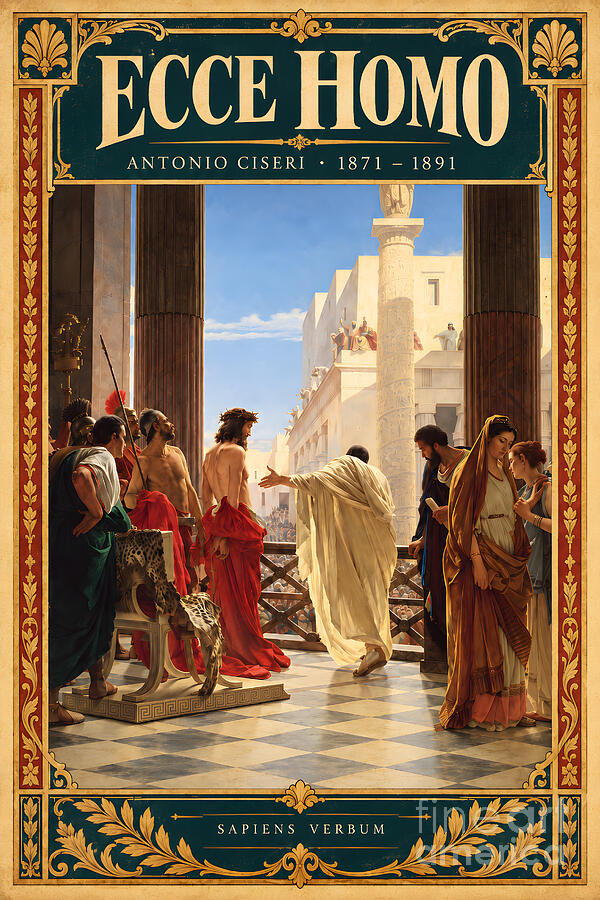
🖼️ Get the vintage poster →License this image →
What: The birth of the painter Antonio Ciseri
When: 25 October 1821
Where: Ronco sopra Ascona, Switzerland; he worked in Florence and died there on 8 March 1891
The painting: Ecce Homo, commissioned in 1871 and finished in 1891, Gallery of Modern Art, Palazzo Pitti
Section: On This Day in Art + Weekly Roundup
What happened
Ciseri left Switzerland as a boy. In 1833 he went to Florence to study drawing, and by 1834 he was a pupil at the Accademia di Belle Arti, where he trained under Pietro Benvenuti and later Giuseppe Bezzuoli. From 1849 he taught young painters himself and eventually ran his own private school; among his early students was Silvestro Lega, later one of the Macchiaioli. He painted altarpieces for churches in Italy and Switzerland, among them two large pictures for the sanctuary of the Madonna del Sasso above Locarno, and in his last twenty years he was much in demand as a portraitist, painting King Umberto I and Queen Margherita of Savoy.
Why it matters
Ciseri belongs to a generation that tried to paint the Gospels as real history. His pictures keep the clear outlines and polished surfaces of Raphael, but their light and detail are almost photographic. The Uffizi Galleries, which look after the painting, describe his Ecce Homo as a true “mise-en-scène”, drawing on the Italian theatre of the time, on photographic technique and on Ernest Renan’s Life of Jesus, the famous book that told Christ’s story as history. When the painting was shown in his studio immediately after his death in 1891, it won over even critics who had never admired his work.
The painting behind the story
The subject comes from the Gospel of John: after Jesus has been scourged and crowned with thorns, Pilate brings him out before the crowd and says “Behold the man”, in Latin Ecce homo. Ciseri places us behind the scene, on a sunlit loggia above the square. Pilate, in pale robes, presents Jesus to the people with a wide gesture of his arm. Both are seen from behind: Christ, crowned with thorns and with his hands bound, stands on the left with a red cloak fallen to his waist. As the Uffizi notes, nobody shows their face except Pilate’s wife, who stands with her servant on the right, eyes lowered, as if whispering her conviction that Christ is innocent. The Italian government commissioned the painting in 1871, and Ciseri worked on it for almost twenty years. For another Passion scene in our shop, see El Greco’s Christ Carrying the Cross.
Hang Ciseri’s Ecce Homo — the sunlit loggia, the crowd below and the moment of “Behold the man” — as a vintage art poster from the Sapiens Verbum print shop.
 Choose your size and frame →
See the religious vintage poster collection →License this image →
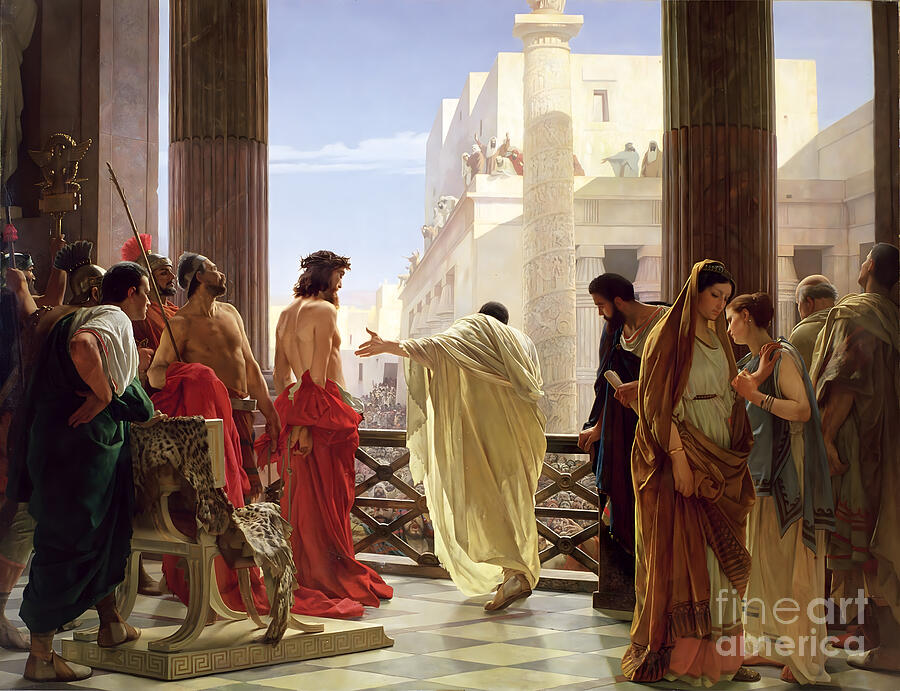
Hang Ciseri’s Ecce Homo as he painted it, with every figure on the loggia in place, as a print, canvas or framed print from the Sapiens Verbum print shop.
 Choose your size and frame →
Printed and shipped by Fine Art America · 30-day money-back guarantee
Also on this day
The English landscape painter Richard Parkes Bonington was born on 25 October 1802, and the American painter and teacher William Merritt Chase died on 25 October 1916.
The week in Sapiens Verbum Daily
- Museums & Exhibitions: Zurbarán came to the Louvre, with the bound lamb of his Agnus Dei.
- Discoveries & Restorations: Egypt restored the Tondo of the Two Brothers before the Fayum faces travel to Rome.
- Auctions & Market: Cézanne’s Harlequin, unseen for half a century, heads to Sotheby’s.
- Law & Restitution: The Caravaggio question in Vilnius: which Taking of Christ is the real one?
- Places & Heritage: Herculaneum reopened two Roman houses, a rich family’s mosaic and the flats next door.
- Books & Ideas: Six new books, one silent painter: the battle over who Vermeer really was.
💬 Over to you: Ciseri shows Christ and Pilate from behind, so we stand where they stand and face the crowd. Does that make the scene stronger or more distant for you? And where in the world are you reading from? Tell us in the comments.
Comments
Post a Comment