Egypt Restores the Tondo of the Two Brothers: Fayum Faces Head to Rome
Two young men look out from a round wooden panel, side by side, as they have for almost nineteen centuries. On 11 October 2026 the Egyptian Museum in Tahrir Square, Cairo, unveiled the newly restored Tondo of the Two Brothers, one of the most famous portraits to survive from Roman Egypt. After three weeks of work by Egyptian and Italian conservators, the painting is getting ready for its first trip abroad: an exhibition of Fayum portraits at the Ara Pacis Museum in Rome, opening in November.
🖼️ Get this painting as a print →
What: Restoration of the Tondo of the Two Brothers, a Roman-period mummy portrait
Where: Egyptian Museum, Tahrir Square, Cairo
When: Unveiled 11 October 2026, after a three-week conservation campaign
Who: Egyptian Museum conservators with specialists from Fabrica Conservazione e Restauro, Rome
Next: Il potere del ritratto: Egitto e Roma, i volti del Fayum, Ara Pacis Museum, Rome, 5 November 2026 – 2 May 2027
Section: Discoveries & Restorations
What happened
The tondo is a round panel made of two halves joined vertically, painted in encaustic, that is, with pigment mixed into hot wax. It shows two young men side by side, with small figures of gods above their shoulders. It comes from Antinoe (Antinoopolis) in Middle Egypt, and the Egyptian Museum dates it to the reign of the emperor Hadrian, around 117–138 CE. The museum says the two men are “believed” to be brothers; the name is a tradition, and some scholars have suggested other relationships.
The restoration was a joint Egyptian-Italian project. Wood-boring insects had tunnelled through the old wooden support, and the paint near the losses had lost its firm backing. An earlier repair had also put fragments of the mouth and chin of the man on the right back in the wrong place. According to reports from Cairo, the conservators repositioned and reinforced these pieces, supported them with balsa wood and recovered the features of the second brother. Ultraviolet examination also suggested that an ancient transparent varnish may survive in the men’s hair, though this still needs further analysis.
Egypt’s minister of tourism and antiquities, Sherif Fathy, called the work “an important example of what can be achieved through international cooperation”. Aly Abdel Halim, director general of the Egyptian Museum in Tahrir, said both the support and the paint were fragile and needed careful intervention.
Why it matters
This will be the first time the tondo and its companions from the Cairo collection leave Egypt. The Rome exhibition, organised by MondoMostre, brings together more than 110 objects: painted portraits, funerary shrouds, masks, marble portraits, plaster casts and jewellery. Alongside the loans from the Egyptian Museum, the Kom Aushim Museum and the Hurghada Museum, there are works from the Louvre, the Getty, the Metropolitan Museum of Art and the Landesmuseum Württemberg in Stuttgart. Fewer than a thousand Fayum portraits survive worldwide, so seeing this many together is rare.
These portraits are the faces of real people. They were painted on wooden panels and placed over the face of the mummy, so that the dead looked out from their wrappings with open eyes. They mix three worlds: Egyptian burial customs, Greek painting techniques and Roman fashions in hair, jewellery and dress. That is why they look so startlingly modern to us, more like portraits from a Renaissance workshop than relics of the ancient world.
The painting behind the story
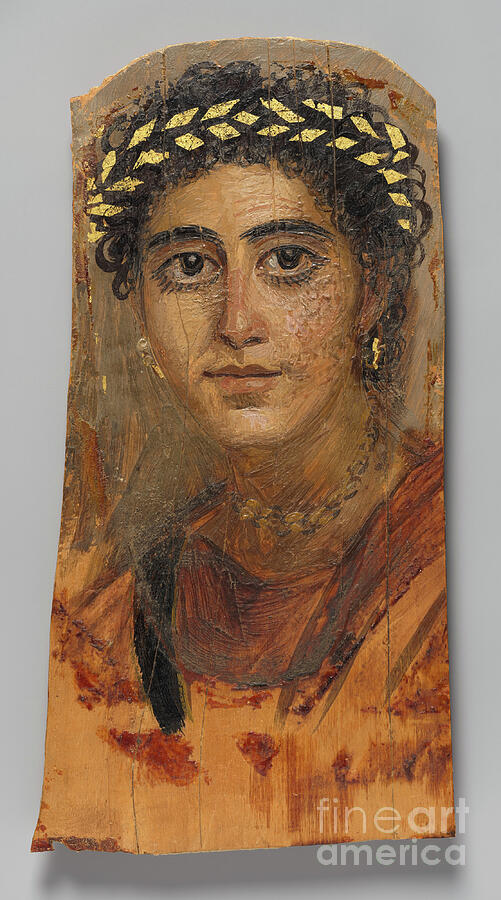
The portrait at the top of this story is not the Cairo tondo but one of its relatives in New York: the Portrait of a Young Woman in Red at the Metropolitan Museum of Art, dated by costume, hairstyle and jewellery to 90–120 CE. A young woman with dark curls and a wreath of gold leaf looks straight at us with large, serious eyes. The Met notes that the background was originally gilded, to stress the divine status of the dead woman. A technical study of the Met’s portraits, published by the Getty, found that it was painted directly on a thin panel of lime wood, with no ground layer; that a fluid underdrawing lies beneath the paint; and that the panel was cut down roughly with a knife after it was painted, to fit the mummy bundle. Her dark red tunic was coloured with a red lake that may have been made from dyed textile waste. For another face that seems to look straight back at the viewer across the centuries, read our essay on Vermeer’s Girl with a Pearl Earring.
Hang the Portrait of a Young Woman in Red — the gold wreath, the dark curls, the gaze across nineteen centuries — as a print, canvas or poster from the Sapiens Verbum print shop.
 Choose your size and frame →
Printed and shipped by Fine Art America · 30-day money-back guarantee
💬 Over to you: Brothers, friends or something else? When you look at two faces painted side by side almost 1,900 years ago, what do you think connects them? And where in the world are you reading from? Tell us in the comments.
Sources
- Associated Press (via ABC News): Egypt’s Fayoum mummy portraits to travel abroad for first time after restoration, 11 October 2026
- Art in Context: Egypt Restores Tondo of the Two Brothers Before First Foreign Loan, 13 October 2026
- Voice of Emirates: The “Egyptian Brothers” painting reveals its secrets, 14 October 2026
- The Metropolitan Museum of Art: Portrait of a young woman in red, 09.181.6
- Getty Publications: Exploring Artistic Practice in Roman Egypt: A Study of Nine Portraits at The Metropolitan Museum of Art
- World History Encyclopedia: Tondo of the Two Brothers
Comments
Post a Comment