Six New Books, One Silent Painter: The Battle Over Who Vermeer Really Was
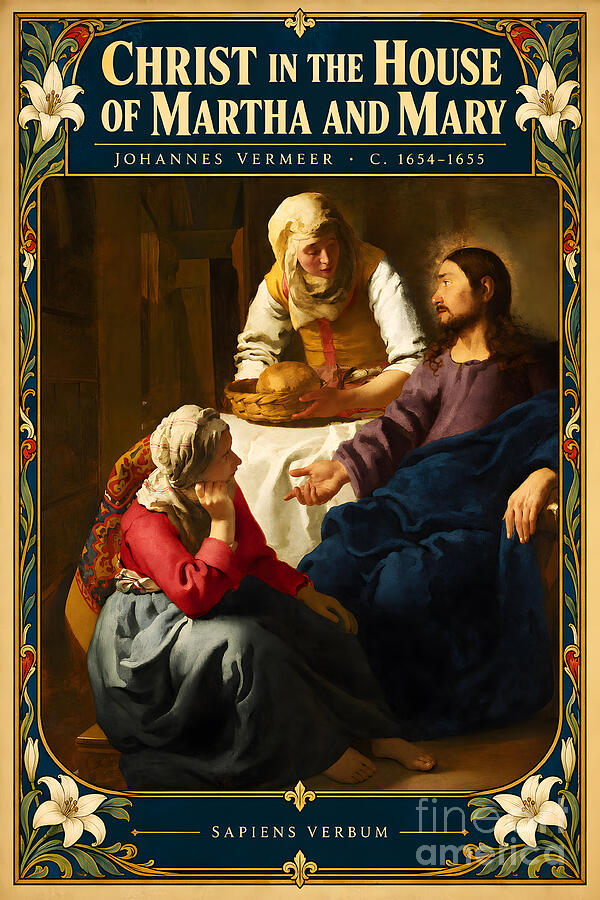
Johannes Vermeer left fewer than forty paintings and almost no words, and that silence is now filling whole shelves. In the issue of The New York Review of Books dated 5 November 2026, the art historian Susan Tallman reviews six recent books on the painter of Delft at once. Each one offers its own key to the man: a camera, a daughter, a hidden faith, a circle of radical Christians. Her conclusion is that the mystery may be the point. The picture below is our vintage poster of the painting at the centre of the faith debate, Vermeer's Christ in the House of Martha and Mary; the original is shown further down.
🖼️ Get the vintage poster →License this image →
What: A review essay on six new books about Johannes Vermeer
Where: The New York Review of Books, issue of 5 November 2026; the painter's city is Delft, the Netherlands
When: Published online in mid-October 2026
Who: Reviewer Susan Tallman; authors include Andrew Graham-Dixon, Ruth Bernard Yeazell, Philip Steadman, Benjamin Binstock and Gregor J.M. Weber
Section: Books & Ideas
What happened
Tallman's essay, titled “Vermeer's Vanishing Act”, brings together a new wave of books. Closer to Vermeer, edited by a team of curators and scientists, collects recent technical research on the paintings. Ruth Bernard Yeazell's Vermeer's Afterlives (Princeton) follows how the painter was rediscovered in the nineteenth century and turned into a hero of modern art. Philip Steadman's Vermeer's Camera returns to the camera obscura. Benjamin Binstock's Vermeer's Family Secrets argues that the artist's eldest daughter painted some of the pictures. Gregor J.M. Weber's Johannes Vermeer: Faith, Light and Reflection reads the work through Vermeer's Catholic faith and his links to the Jesuits of Delft.
The biggest book is Andrew Graham-Dixon's Vermeer: A Life Lost and Found (Norton in the United States). According to Publishers Weekly and to Tallman, Graham-Dixon argues that Vermeer worked mainly for patrons connected with the Collegiants, a tolerant Dutch Protestant movement without clergy, above all the collector Pieter van Ruijven and his wife Maria de Knuijt. Tallman finds the case ingenious but built on speculative links; Prospect's reviewer, Christopher Bray, was harder, calling its interpretations overreaching.
Why it matters
Vermeer is the perfect subject for this kind of argument because the documents are so thin. We know where he was baptised, whom he married, how many children he had and how much he owed when he died in 1675. We do not have a single letter about his art. Every theory has to be built from the paintings themselves, and the paintings are designed to withhold: a woman reads a letter we cannot see, a girl turns to us and says nothing. Tallman's point is that this restraint is not a gap to be filled but the reason the pictures still hold us. For readers, the debate is useful in another way: each book sends you back to look harder at the same few canvases.
The painting behind the story
If any picture tests the faith question, it is Christ in the House of Martha and Mary, Vermeer's largest painting and his only scene from the Bible, painted in the mid-1650s soon after his marriage to Catharina Bolnes, whose family was Catholic. Christ sits in a dark room, turning towards Martha, who brings bread, while her sister Mary sits at his feet and listens. It hangs today in the Scottish National Gallery in Edinburgh. You can read the whole story in our essay Christ in the House of Martha and Mary by Vermeer, and see the painter's quieter side in The Milkmaid.
Vermeer's only Bible scene, Martha with her bread and Mary at Christ's feet, as a vintage art poster from the Sapiens Verbum print shop.
 Choose your size and frame →
See the vintage poster collection →License this image →
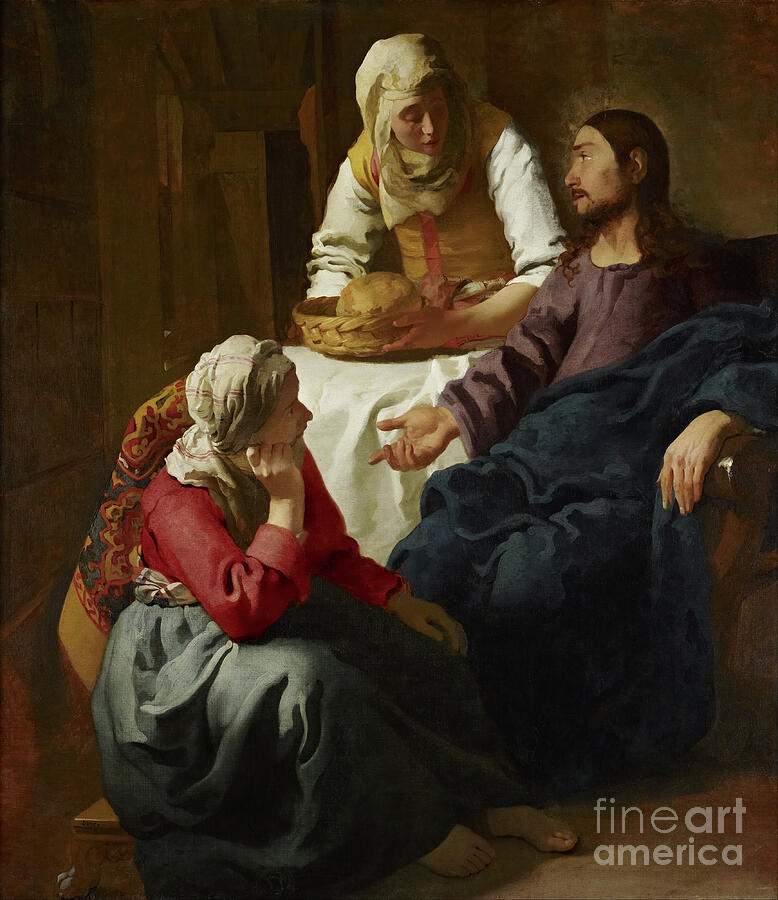
Hang Vermeer's canvas as he painted it, as a print, canvas or framed print from the Sapiens Verbum print shop.
 Choose your size and frame →
Printed and shipped by Fine Art America · 30-day money-back guarantee
💬 Over to you: Which key to Vermeer do you find most convincing: the camera, the faith, the daughter or none of them? And where in the world are you reading from? Tell us in the comments.
Comments
Post a Comment