Herculaneum Reopens Two Roman Houses: A Mosaic Mansion and Roman Flats
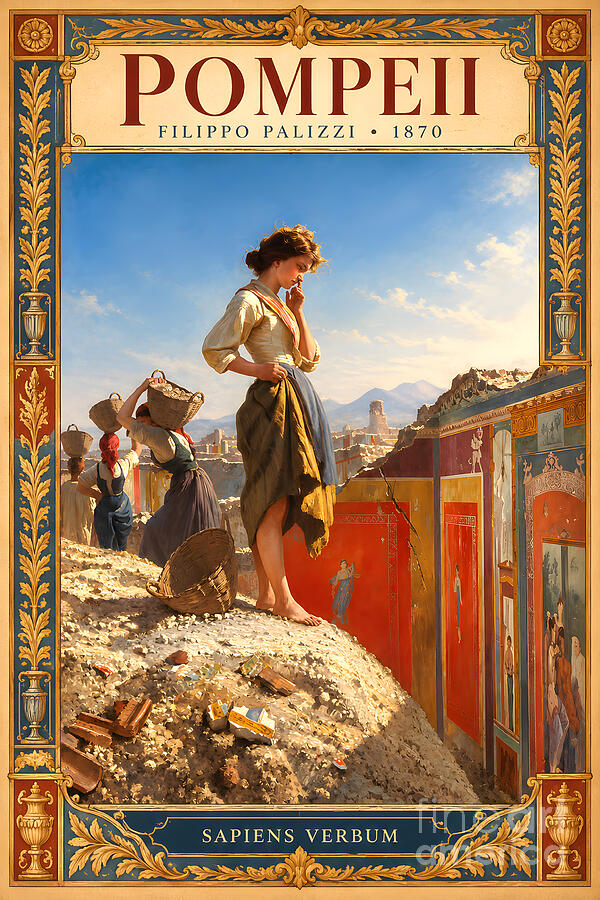
Two Roman houses buried by Vesuvius in AD 79 are open to visitors again after decades behind closed doors. On Wednesday 21 October 2026 the Archaeological Park of Herculaneum, in Ercolano on the Bay of Naples, presented the reopening of the House of the Mosaic Atrium and the House of Opus Craticium (in Italian, the Casa dell’Atrio a Mosaico and the Casa a Graticcio). The park describes them as two of the most important homes of the ancient town. One was the home of a wealthy family; the other was a cheaply built block where several households lived on top of each other. The picture below is our vintage poster of a nineteenth-century view of the excavations nearby at Pompeii; the painting itself is shown further down.
🖼️ Get the vintage poster → License this image →
What: Reopening of the House of the Mosaic Atrium and the House of Opus Craticium
Where: Archaeological Park of Herculaneum, Ercolano (Naples), Italy
When: Presented on 21 October 2026
Who: Park director Federica Colaiacomo, with the Packard Humanities Institute
Programme: Progetto Domus, conservation of six of the town’s most important houses, funded with €5 million
Section: Places & Heritage
What happened
The reopening is the latest stage of the Progetto Domus, a conservation programme for six of the most significant houses of ancient Herculaneum. According to the park, the project is a collaboration with the Packard Humanities Institute, through its Packard Institute for Cultural Heritage, and is funded with €5 million from the “Vesuvio – Pompei – Napoli” development contract. Earlier stages brought back the House of the Tuscan Colonnade and the House of the Wooden Shrine in March 2025, and the House of the Carbonised Furniture in July 2026. The park announced the two new reopenings on 9 October and presented them to the press at the Antiquarium on 21 October. From 15 October the site is on winter hours, open from 8:30 to 17:00.
Why it matters
The two houses show the two ends of Roman society in a single small town. The House of the Mosaic Atrium takes its name from the black-and-white chessboard mosaic around the basin of its atrium, the sunken pool that collected rainwater. The weight of the volcanic material that buried the town left the floor buckled and wavy, so that the mosaic itself records the eruption. Behind it lies a large garden surrounded by porticoes on three sides.
The House of Opus Craticium is the opposite. It was built with a cheap technique of timber frames filled with rubble, which the Roman architect Vitruvius criticised as a serious fire risk. Its upper floor was divided between several households and had a balcony on brick columns over the street. Because Herculaneum was buried by hot volcanic flows rather than by falling ash, wood here was carbonised instead of rotting away, and this house is one of the rare places where you can still see how ordinary Romans lived in flats. Seeing both houses on the same visit is a lesson in what the eruption preserved: not only the villas of the rich but the everyday homes of their neighbours.
The painting behind the story
Our shop has no painting of these two houses, so the closest match is the painting behind our poster, shown further down this story: Filippo Palizzi’s view of the excavations at Pompeii, Herculaneum’s larger neighbour, buried by the same eruption. Palizzi (1818–1899) was a Neapolitan-trained painter of everyday life and animals. Here a young woman in a white dress pauses at the edge of the dig to look at the painted walls of a newly uncovered house, while women carry away the earth in baskets. The Fondazione Zeri catalogue records the canvas, 119 by 86 cm, in a private collection in Milan after a sale at Sotheby’s in 2009. It is a reminder that the Vesuvian cities were excavated by hand, basket by basket, and that the visitors of the nineteenth century were already as fascinated as we are.
Bring the excavations of the Bay of Naples home — the young visitor among the painted Roman walls, framed in a Pompeian border — as a vintage art poster from the Sapiens Verbum print shop.
 Choose your size and frame →
See the vintage poster collection →License this image →
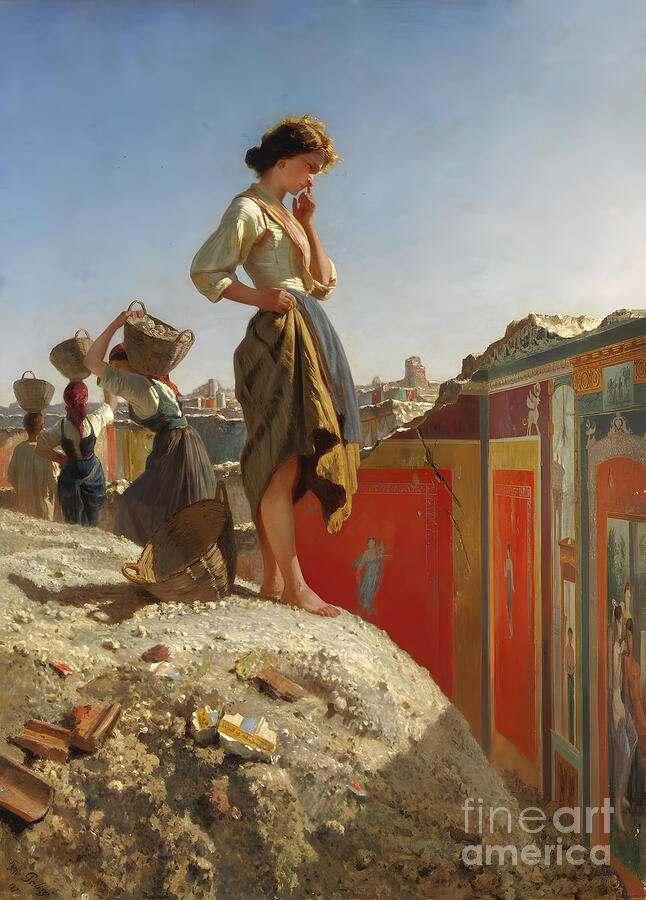
Hang Palizzi’s canvas as he painted it, the young visitor among the painted ruins, as a print, canvas or framed print from the Sapiens Verbum print shop.
 Choose your size and frame →
Printed and shipped by Fine Art America · 30-day money-back guarantee
💬 Over to you: If you could spend an hour in one of these houses, which would you choose: the rich family’s home with its mosaic and garden, or the crowded flats upstairs? And where in the world are you reading from? Tell us in the comments.
Sources
- Parco Archeologico di Ercolano: press conference, 21 October 2026 (in Italian)
- TVCity: Ercolano, riaprono Casa dell’Atrio a Mosaico e Casa a Graticcio, 9 October 2026
- Archaeological Park of Herculaneum: winter hours
- Rome Art Lover: Herculaneum, the House of the Mosaic Atrium
- Wikipedia: Opus craticum
- Fondazione Zeri catalogue: Filippo Palizzi
Comments
Post a Comment