The Caravaggio Question in Vilnius: Which Taking of Christ Is the Real One?
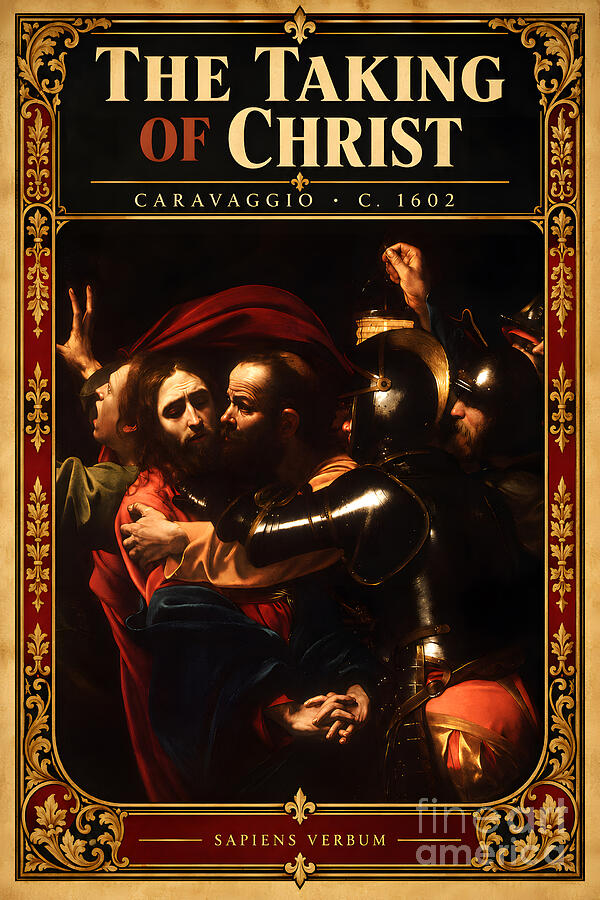
A kiss in the dark, seven figures jammed into a night scene, a soldier’s polished black armour cutting across the middle like a mirror. Judas still grips Christ. On the right a man holds a lantern, often read as Caravaggio himself. The composition is one of the most famous betrayal scenes in Western painting. At least twelve versions are known. One of them, long in Odesa, is now on show in Vilnius until 2 May 2027. The picture below is our vintage poster version of the Dublin canvas, the one most scholars treat as the original; further down you will find the same painting as a fine-art print.
🖼️ Get the vintage poster → License this image →
What: The Caravaggio Question: The Painting The Taking of Christ exhibition
Where: Vilnius Picture Gallery, Lithuanian National Museum of Art
When: 9 June 2026 – 2 May 2027
Centrepiece: Version from the Odesa Museum of Western and Eastern Art (stolen 2008, recovered, restored 2018–2021)
Related work: Dublin original, National Gallery of Ireland, on long-term loan from the Jesuit community
Section: Law & Restitution
What is on show
The Vilnius exhibition places the Odesa canvas at the centre of a larger question about copies, imitations and attribution. Ciriaco Mattei paid Caravaggio 125 scudi for a Taking of Christ around 1602. A little over a decade later his brother commissioned a copy from Giovanni di Attilio for 12 scudi. One widely held view is that the Odesa painting is that early copy. The Dublin canvas, rediscovered in 1990 in a Jesuit dining room and identified by Sergio Benedetti, is regarded by the National Gallery of Ireland as the original. The Odesa version also has a criminal history. In 2008 thieves cut the canvas out of its stretcher and stole it from the Odesa museum; it was found a couple of years later in Berlin, badly damaged, during a joint police operation. Conservation began in Ukraine about ten years after the theft. According to the Lithuanian National Museum of Art, the court case over the theft ended this year when the limitation period expired, and the painting was then shown in Kyiv before travelling to Vilnius. It arrived in Lithuania under armed escort earlier this year, a practical act of protection as much as a cultural loan.
Why it matters
Only a few dozen paintings are generally accepted as Caravaggio’s own. Every contested version therefore carries weight. The Vilnius show, accompanied by technical examination at the Pranas Gudynas Conservation Centre and an international conference on copies and forgeries in mid-October 2026, treats the Odesa picture as a document of how art history is written rather than as a settled original. Meanwhile the Dublin painting remains the one that most clearly matches the account of Mattei’s purchase and the visual force of Caravaggio’s Roman years. Both canvases keep the same compressed night, the same armour, the same lantern. The difference is in the handling, the condition and the chain of ownership.
The painting behind the story
The Dublin Taking of Christ (1602) is oil on canvas, roughly 133.5 by 169.5 cm. It hung unrecognized for decades before the 1990 discovery. Our print reproduces that version, and we look at it in depth in our essay on Caravaggio’s Taking of Christ. The lantern-bearer, the black armour, the moment of the kiss: these are the elements that survive across the copies and that still define the picture. For another recent Caravaggio story, see the Italian state’s €30 million purchase of the Portrait of Monsignor Maffeo Barberini for Palazzo Barberini earlier this year.
Hang Caravaggio’s Taking of Christ — the kiss, the black armour, the lantern in the dark — as a vintage art poster from the Sapiens Verbum print shop.
 Choose your size and frame →
See the vintage poster collection →License this image →
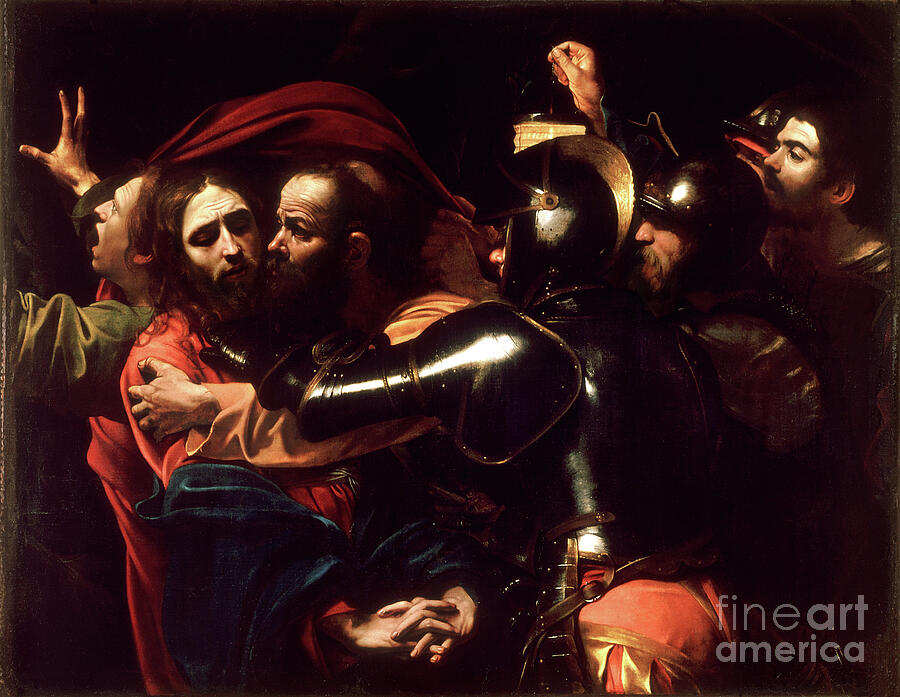
Hang Caravaggio’s Taking of Christ as he painted it, as a print, canvas or framed print from the Sapiens Verbum print shop.
 Choose your size and frame →
Printed and shipped by Fine Art America · 30-day money-back guarantee
💬 Over to you: Twelve versions, one Dublin rediscovery, one Odesa canvas now in Vilnius. Which story interests you more—the original found in a dining room, or the disputed copy rescued from a war zone? And where in the world are you reading from? Tell us in the comments.
Comments
Post a Comment