Saint Luke's Day: Holman Hunt's Finding of the Saviour in the Temple, Plus the Week in Review
Today, 18 October, is the feast of Saint Luke the Evangelist, the patron saint of painters. Luke is the only Gospel writer who tells the story of the twelve-year-old Jesus lost in Jerusalem and found three days later in the Temple, sitting among the teachers. One of the most ambitious Victorian paintings of that scene, William Holman Hunt’s The Finding of the Saviour in the Temple, hangs today in Birmingham.
What: The feast of Saint Luke the Evangelist, patron saint of painters
When: 18 October
The story: Luke 2:41–52, the boy Jesus found in the Temple, told only in Luke’s Gospel
The painting: William Holman Hunt, The Finding of the Saviour in the Temple, 1854–1860, Birmingham Museum and Art Gallery
Section: On This Day in Art + Weekly Roundup
What happened
Saint Luke is remembered on 18 October. Saint Paul calls him “the beloved physician”, and he is traditionally the author of the third Gospel and of the Acts of the Apostles. A much later tradition made him a portrait painter too: he was believed to have painted the Virgin Mary from life, and several famous images of the Virgin were credited to his hand. From the late thirteenth century, as painters in Northern Europe organised themselves into guilds, many of those guilds took Luke as their patron saint, and “Guild of Saint Luke” became the usual name for a painters’ guild. The best-known picture of the legend, Rogier van der Weyden’s Saint Luke Drawing the Virgin of about 1435–1440, now in the Museum of Fine Arts, Boston, was almost certainly made for the painters’ guild of Brussels.
Luke’s Gospel also gave painters some of their favourite subjects, because many of its stories appear nowhere else: the Annunciation to Mary, the shepherds at the Nativity, the parables of the Prodigal Son and the Good Samaritan, and the episode in this painting. After the Passover in Jerusalem, Mary and Joseph start home and realise that Jesus, now twelve, is not with them. They search for three days and find him in the Temple, listening to the teachers and asking them questions. “Son, why hast thou thus dealt with us?” his mother asks, and he answers: “Wist ye not that I must be about my Father’s business?”
Why it matters
For centuries painters set the scene as a debate, the “Christ among the Doctors”. Hunt, one of the founders of the Pre-Raphaelite Brotherhood, wanted something else: the moment of finding, painted with the truth of a place he had seen. He travelled to the Middle East in 1854, studied the customs and rituals of ancient Judaism, and used local people as models. Work stalled when models proved hard to find, he set the canvas aside to paint The Scapegoat, and he finished it in England only in 1860. The ornate temple interior owes something to London too: according to National Museums Liverpool, it was composed from the Alhambra Court at the Crystal Palace.
The result was a sensation and a business. Hunt sold the painting, together with its copyright, to the dealer Ernest Gambart for 5,500 guineas. Gambart sent it on popular touring exhibitions, where visitors could buy an explanatory pamphlet by the critic Frederic George Stephens and subscribe to the engraving. Thomas Carlyle, in a letter of April 1860, called Hunt’s Christ “an exquisite mixture of a god and a peasant lad”.
The painting behind the story
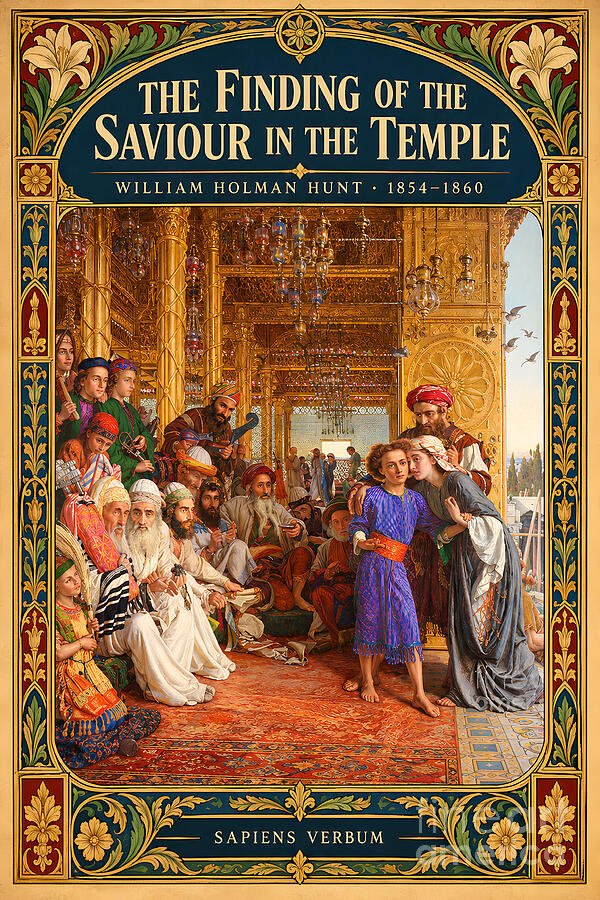
The composition is split in two. On the left, the rabbis sit in a crowded, glittering hall: an old man with a white beard clutches a scroll in its embroidered cover, others hold scrolls and instruments, and a child with a palm fan stands at the edge. On the right, almost turning their backs on them, Mary bends to embrace her son, her face pressed against his, while Joseph stands behind with a hand on the boy’s shoulder. Jesus, in a striped blue-and-violet robe with a red sash, is caught between the two worlds: his body leans toward his mother, but his eyes look far away. Through the open door at the far right, building work goes on in the sunlit courtyard. The image at the top of this story is our vintage poster version of the painting, with Hunt’s canvas set in a frame of lilies and Art Nouveau ornament; the original canvas is shown below. For Hunt’s most famous religious image, read our new essay on The Light of the World, and for a very different Christ painted as an image for prayer, El Greco’s Christ Carrying the Cross.
Hang Holman Hunt’s The Finding of the Saviour in the Temple as a vintage art poster by Sapiens Verbum, framed by lilies and Art Nouveau ornament.
 Choose your size and frame →
See the vintage poster collection →
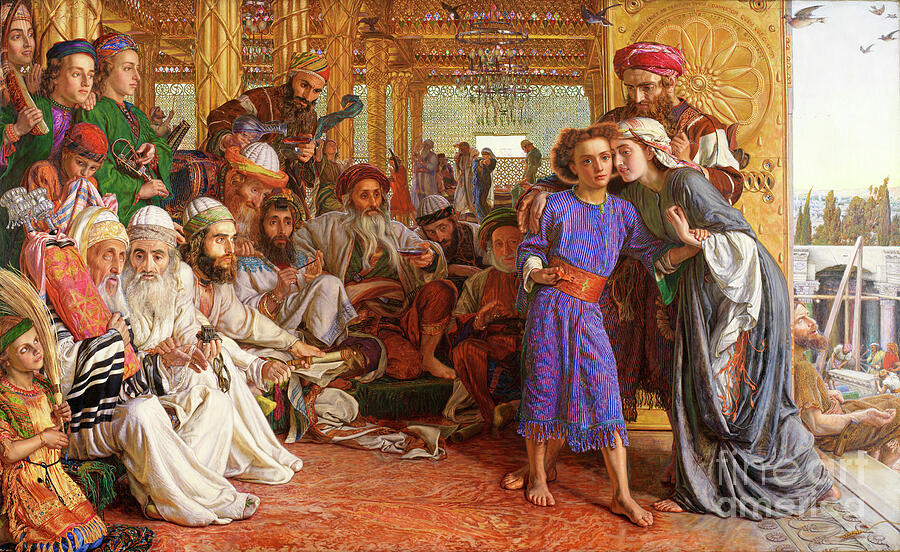
Hang Holman Hunt’s The Finding of the Saviour in the Temple as he painted it — the golden hall, the rabbis and Mary’s embrace — as a print, canvas or poster from the Sapiens Verbum print shop.
 Choose your size and frame →
Printed and shipped by Fine Art America · 30-day money-back guarantee
The week in Sapiens Verbum Daily
- Museums & Exhibitions: Ten Van Goghs returned to Paris as the Fondation Louis Vuitton revived the collector Gustave Fayet.
- Law & Restitution: Stolen Renoirs were found behind a wall, as DNA cracked the Cagnes-sur-Mer museum heist.
- Art Market: A Rothschild Brueghel returned to the spotlight at Frieze Masters 2026.
- Exhibitions: A White House Whistler crossed the Atlantic to go on show at the Van Gogh Museum.
- Art Market: Kandinsky’s Das bunte Leben, seized in 1940, sold for £31.6 million at Christie’s London.
- Books & Ideas: Gainsborough vs Reynolds: a new book revisits Georgian London’s great art rivalry.
💬 Over to you: Hunt shows the moment of finding rather than the debate with the teachers. Which story from Luke’s Gospel do you think painters have told best? Tell us in the comments.
Comments
Post a Comment