Stolen Renoirs Found Behind a Wall: DNA Cracks the Cagnes-sur-Mer Museum Heist
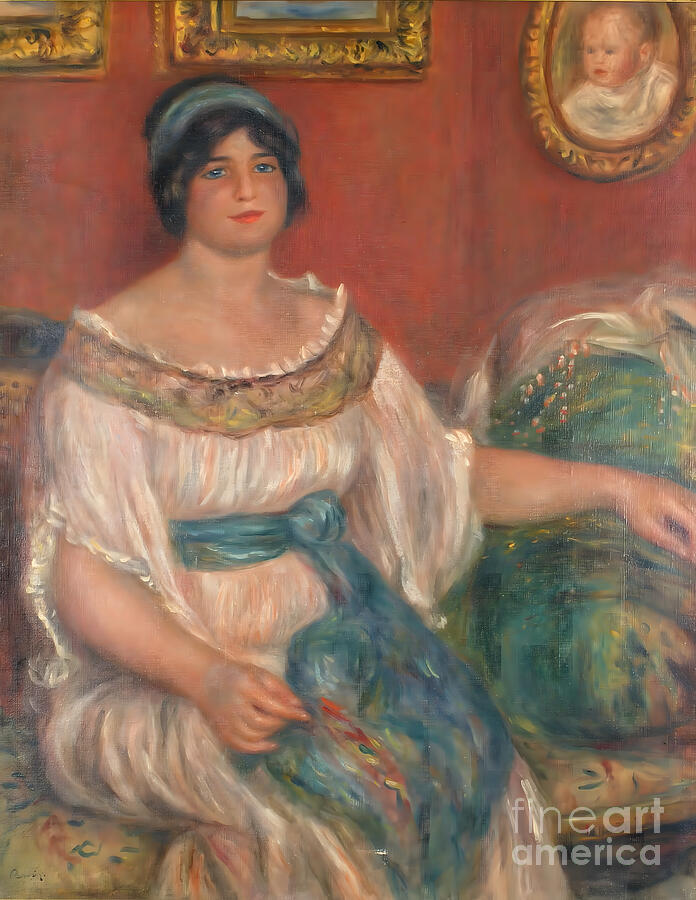
A month after thieves cut through a fence and lifted four paintings off the walls of Renoir’s last home, the two pictures they managed to carry away are safe again. On 12 October 2026 the Marseille prosecutor announced that DNA left on a protective cover had led police to the suspects, and that Portrait of Madame Colonna Romano and Young Woman at the Well had been found hidden behind a wall built under a staircase. Both are now being examined in a conservation laboratory in Marseille before they go home to Cagnes-sur-Mer.
🖼️ Get Renoir’s Cagnes as a print →
What: Recovery of two Renoir paintings stolen from the Musée Renoir
Where: Musée Renoir, Cagnes-sur-Mer, French Riviera; now at the CICRP conservation centre, Marseille
When: Stolen 8 September 2026; found 8 October; announced 12 October 2026
Who: Pierre-Auguste Renoir (1841–1919); works on deposit from the Musée d’Orsay
Section: Law & Restitution
What happened
The raid took place at dawn on 8 September. According to Nice-Matin, two men cut through the fence of the estate, the alarm went off at 5.48 a.m. and police arrived within minutes. The thieves had already unhooked four of the twelve paintings in the house. In their hurry they dropped two of them, Coco Reading and the Portrait of Madame Stephen Pichon, in the garden. The other two disappeared. Local officials put the total value of the four at around nine million euros.
The Associated Press reports that prosecutor Nicolas Bessone told journalists on Monday that DNA on the abandoned protective sleeve matched a 29-year-old man whose car was already being tracked in a drugs inquiry. The tracking data led investigators to a third man, who admitted hiding the paintings behind a wall under his stairs. Four men have been given preliminary charges, including organised theft and receiving stolen goods. Bessone said the arrests were speeded up because police suspected another heist was imminent: one suspect had visited the Fondation Maeght in Saint-Paul-de-Vence on 3 October.
What state are the paintings in?
Better than many feared. The portrait of Madame Colonna Romano has a tear in the canvas; Young Woman at the Well has slight damage to its frame. The prosecutor valued the pair at 4.2 million euros. The French Ministry of Culture announced on 12 October that both have been sent to the Centre interdisciplinaire de conservation et de restauration du patrimoine (CICRP) in Marseille, where specialists will examine them and, if needed, restore them under the scientific responsibility of the Musée d’Orsay. Only then will they go back on the walls in Cagnes.
Why it matters
The two pictures are not ordinary loans. Nice-Matin notes that both belong to the MNR category, works recovered from Germany after the Second World War and entrusted to the French national museums while their original owners are sought. That status does not by itself prove they were looted, but it does mean France holds them in trust. They have been on deposit in Cagnes since 1995.
The theft also adds to a worrying run. It came a year after the crown jewels were stolen from the Louvre, and only months after a Renoir, a Cézanne and a Matisse were taken from the Fondazione Magnani Rocca near Parma and later recovered. France’s head of judicial police said museums recorded 23 thefts in 2025 and about ten so far this year. Small house museums, with real rooms, real windows and gardens, are among the hardest places to protect.
The painting behind the story
Madame Colonna Romano was a French actress, later a member of the Comédie-Française, who sat for Renoir several times in his last years. By then the painter was crippled by arthritis and living at Les Collettes, the farmhouse among olive trees in Cagnes where he spent his final decade and where he died in 1919. His late portraits are soft and glowing: warm reds, rounded forms and brushwork that seems to melt the edges of the face into the background. Seeing one of them back in the house where it was painted is the whole point of the Musée Renoir, which is why its loss hurt so much. For more of the painter, explore the Renoir paintings we’ve explained.
Hang the recovered Portrait of Madame Colonna Romano as a print, canvas or poster from the Sapiens Verbum print shop.
 Choose your size and frame →
Printed and shipped by Fine Art America · 30-day money-back guarantee
💬 Over to you: Should small house museums like Renoir’s home keep showing original masterpieces, or hang copies and keep the originals in safer galleries? Tell us in the comments.
Sources
- PBS News / Associated Press: How DNA and vehicle-tracking helped French investigators recover stolen Renoirs, 12 October 2026
- Ministère de la Culture: Les deux tableaux de Renoir dérobés au musée de Cagnes-sur-Mer sont transférés au CICRP de Marseille, 12 October 2026
- Nice-Matin: Cambriolage au musée Renoir à Cagnes-sur-Mer, les deux tableaux retrouvés
- BFMTV: Ce que l’on sait sur le cambriolage du musée Renoir de Cagnes-sur-Mer, 8 September 2026
Comments
Post a Comment