Gainsborough vs Reynolds: A New Book Revisits Georgian London's Great Art Rivalry
Two of the greatest portrait painters in British history lived a few streets apart in London and spent their careers competing for the same sitters, the same walls and the same reputation. On 16 October 2026, Art History News announced a new book about them: Gainsborough and Reynolds: The Art of Rivalry in Georgian London by the art historian Jacqueline Riding, due from Yale University Press in February 2027, ahead of the 300th anniversary of Thomas Gainsborough’s birth.
🖼️ Get this painting as a print →
What: Gainsborough and Reynolds: The Art of Rivalry in Georgian London, a double biography by Jacqueline Riding (400 pages)
Where: Yale University Press
When: Announced 16 October 2026; publication due 16 February 2027
Who: Thomas Gainsborough (1727–1788) and Sir Joshua Reynolds (1723–1792)
Section: Books & Ideas
What happened
According to Art History News, the book follows the two painters side by side through their homes, their studios, public life and the Royal Academy of Arts. The publisher’s description calls them bitter rivals during their lifetimes and beyond: both came to London from provincial counties, but they differed in character, in their attitude to life and art, and in the paths their careers took. Although they were neighbours, they were rarely in the same room. The setting for their rivalry, the publisher says, was the Royal Academy, which Reynolds led, and above all its annual exhibitions.
The book is listed at 400 pages, with publication in February 2027. It marks the tercentenary of Gainsborough, who was baptised in Sudbury, Suffolk, on 14 May 1727; Reynolds, born in Plympton, Devon, in 1723, was four years older.
Why it matters
The rivalry is one of the great stories of British art. When the Royal Academy was founded in 1768, Reynolds became its first President and Gainsborough one of its founding members. Reynolds championed the “grand style” and set out his ideas in his Discourses to the Academy’s students; Gainsborough, who loved landscape and painted with quick, feathery strokes, went his own way. He quarrelled with the Academy over how his pictures were hung and, from 1784 until his death, refused to show at its exhibitions. Yet the story ends with a reconciliation: in 1788, dying of cancer, Gainsborough wrote to Reynolds of his admiration, and Reynolds visited him in his studio.
The painting behind the story
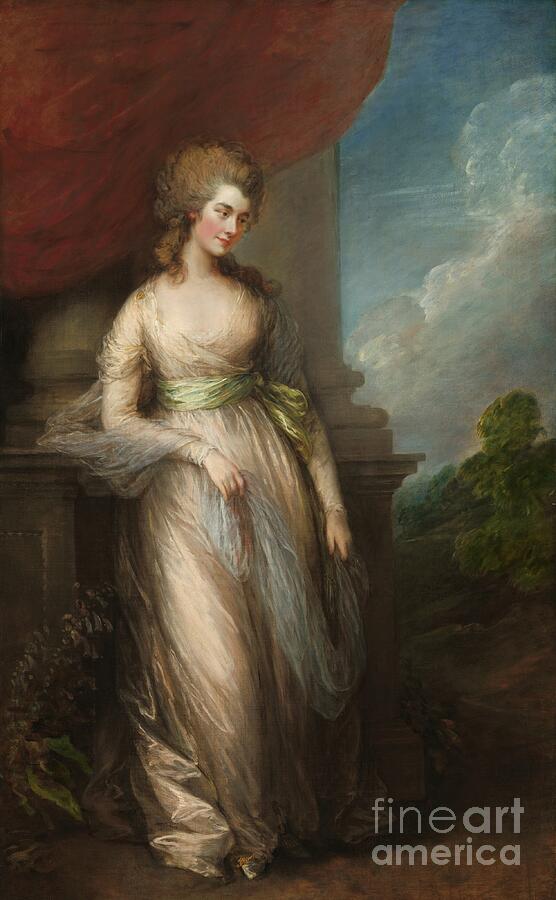
The portrait at the top of this story shows Georgiana, Duchess of Devonshire, the most celebrated woman in Georgian society and a sitter both rivals painted. Gainsborough shows her in a pale silk dress with a green sash, leaning against a stone pedestal under a heavy red curtain, with a windswept sky behind. The National Gallery of Art in Washington records that it was shown at the Royal Academy in 1783 as “Portrait of a lady of quality”, exactly the kind of exhibition where the two painters measured themselves against each other. Reynolds painted her a few years later, with her baby daughter. For another Gainsborough sitter of the same years, see our essay on William Yelverton Davenport, the country squire with a gun.
Hang Gainsborough’s Georgiana — the silk, the green sash and the stormy sky — as a print, canvas or poster from the Sapiens Verbum print shop.
 Choose your size and frame →
Printed and shipped by Fine Art America · 30-day money-back guarantee
💬 Over to you: Gainsborough or Reynolds: whose portraits would you rather live with, and why? Tell us in the comments.
Sources
- Art History News: Upcoming Release: Gainsborough and Reynolds – The Art of Rivalry in Georgian London, 16 October 2026
- Yale University Press: Gainsborough and Reynolds
- Royal Museums Greenwich: The art rivalry of Thomas Gainsborough and Sir Joshua Reynolds
- National Gallery of Art: Georgiana, Duchess of Devonshire, 1783
Comments
Post a Comment