Edgar Degas Died on 27 September 1917: On This Day in Art, Plus the Week in Review
On 27 September 1917, Edgar Degas died in Paris at the age of 83. For half a century he had been one of the sharpest eyes in French painting: he showed ballet dancers rehearsing, racehorses at the start line and women at the laundry, all with an unsentimental precision. He died with the First World War still raging, almost blind, and having painted nothing for five years. What happened to his studio in the months after his death is one reason we can still see so much of his late work today.
What: Death of the painter and sculptor Edgar Degas
Where: Paris, France
When: 27 September 1917 (born in Paris, 19 July 1834)
Who: Edgar Degas, one of the founders of the Impressionist exhibitions
Section: On This Day in Art + Weekly Roundup
What happened
Degas's eyesight had worried him for most of his adult life. His eye problems were first detected in 1870, during rifle training in the Franco-Prussian War, and after 1890 his vision got much worse. He kept working in pastel until about 1907 and probably went on modelling sculptures until around 1910. In 1912 the building on the rue Victor-Massé where he had lived and worked for years was due to be demolished, and he had to move to new rooms on the boulevard de Clichy. After that move he seems to have stopped working altogether. He had never married, and he spent his last years walking the streets of Paris, nearly blind, until his death in September 1917.
Why it matters
When Degas died, his studio was still full of work that had never left it. In 1918, the last year of the war, its contents went to auction at the Galerie Georges Petit in Paris, and many paintings that now hang in museums, including the one below, were sold in public for the first time. His heirs also found about 150 wax sculptures, many of them damaged. Only one of his sculptures, the Little Dancer Aged Fourteen, had ever been shown in public, in 1881. Bronze casts of the waxes were made from 1922, and they are why museums around the world can show Degas the sculptor today.
Degas was also a passionate collector of other artists' work, and his private collection was sold in 1918 too. The National Gallery in London sent its director, Charles Holmes, to Paris with a special wartime grant of £20,000. Holmes shaved off his moustache and wore glasses so that other bidders would not recognise him, and a bomb fell close to his train on the way. He came back with 13 paintings and 8 drawings, among them Gauguin's A Vase of Flowers (1896) and a portrait by Delacroix.
The painting behind the story
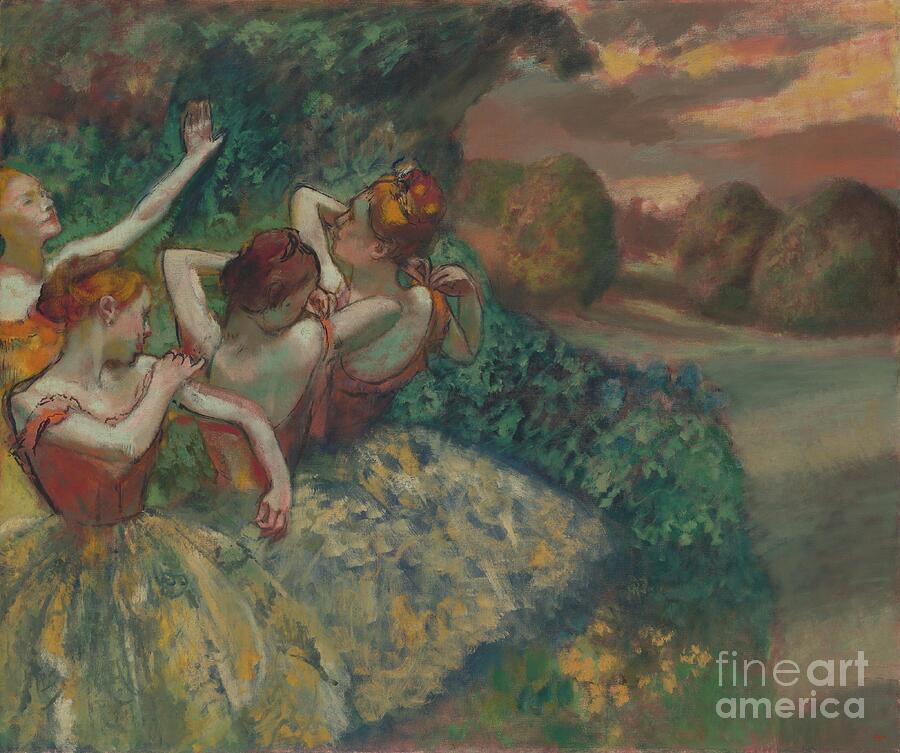
Four Dancers (c. 1899) is one of the paintings that left Degas's studio after he died. According to the National Gallery of Art in Washington, it was lot 10 in the Degas sale at the Galerie Georges Petit on 6 May 1918, and it still carries the studio stamp "Degas" in the lower right corner. It passed through Paris and Copenhagen before the collector Chester Dale bought it in 1931 and left it to the museum in 1963. Four dancers stand close together, adjusting their shoulder straps as if about to go on stage. Yet the background looks less like a stage than a landscape under a blazing sky, and it is hard to tell whether we see four women or one dancer caught in four moments. Painted when his eyesight was already failing, it shows how freely Degas was using color by the end of his career. For another Impressionist view of Parisians at leisure, read our essay on Renoir's Bal du moulin de la Galette.
Get Degas’s Four Dancers as a museum-quality print, canvas, or poster from the Sapiens Verbum print shop.
Shop This Print →
The week in Sapiens Verbum Daily
- Museums & Exhibitions: Eva Gonzalès steps out of Manet's shadow, with her first major retrospective since 1885 at the Petit Palais in Paris.
- Auctions & Market: A small Fragonard lovers scene made €10.6 million as the Patiño collection sold at Christie's Paris.
- Discoveries & Restorations: A lost Velázquez portrait of the Count-Duke of Olivares resurfaced and was acquired by the Getty, the museum's first Velázquez.
- Books & Ideas: The NY Art Book Fair returned to MoMA PS1 for its twentieth edition, fifty years after Printed Matter and PS1 were founded.
💬 Over to you: Ballet dancers, racehorses, laundresses, café life: which of Degas's subjects do you think shows him at his best, and why? Tell us in the comments.
Comments
Post a Comment