Fifty Years of Artists' Books: The NY Art Book Fair Returns to MoMA PS1
This weekend, more than 300 publishers from 41 countries have set up their tables inside MoMA PS1 in Long Island City, Queens, for Printed Matter's 2026 NY Art Book Fair, which opened on Thursday 24 September and runs until Sunday 27 September. The edition is a triple anniversary. The fair turns twenty, and the two institutions behind it, Printed Matter and PS1, both opened to the public in 1976.
What: Printed Matter's NY Art Book Fair 2026, 20th anniversary edition
Where: MoMA PS1, 22-25 Jackson Avenue, Long Island City, Queens, New York
When: 24 September (opening night) to 27 September 2026
Who: Printed Matter, with more than 300 exhibitors from 41 countries
Section: Books & Ideas
What happened
According to Printed Matter, this year's exhibitors range from small presses, zine collectives and self-publishing artists to antiquarian dealers, galleries and museum publishers. Tickets cost $10 a day from Friday to Sunday and $60 for the opening night, a rise the organiser puts down to rising production costs. It also says that no one will be turned away for lack of funds.
The fair's programme includes The Classroom, a series of talks, and The Stage, a music programme curated by Lydo Le. There is also a Reading Room organised with the African Art Book Fair, along with larger presentations in the Project Spaces. Printed Matter uses the fair to present the Shannon Michael Cane Award and the Volume Grant. Artforum's Artguide gives the count as "over 310 exhibitors".
The first NY Art Book Fair took place in Chelsea in 2006 with 73 exhibitors. MoMA PS1 describes this year's edition as part of a "shared milestone" of fifty years in experimental art.
Why it matters
Printed Matter was founded in Tribeca in 1976 by a group of artists and critics that included Sol LeWitt and Lucy Lippard. The idea was simple and radical: artists should control how their work reaches the public, and a book could do that more cheaply and more widely than a gallery. The same year, PS1 opened in a disused 1892 schoolhouse with Rooms, an exhibition that turned its classrooms over to artists. Both were bets on an art world outside the museum and the auction room.
Fifty years later, those two bets meet in the same building. That matters beyond New York. Most people know most paintings through reproductions, first on the printed page and now on screens. For centuries, how a picture was photographed, cropped, captioned and bound has shaped what it meant to its viewers. An art book fair is where that quiet infrastructure of art history becomes visible, and where artists still decide for themselves what goes on the page.
The painting behind the story
No painting in our shop shows an art book fair. The closest match in theme is Vermeer's Woman Reading a Letter (c. 1663), in the Rijksmuseum, Amsterdam. A young woman in blue stands at a table, absorbed in a sheet of paper we are never allowed to read. It is one of the great images of private reading, the kind of attention every table at PS1 is competing for. For more on Vermeer, read our essay on The Milkmaid.
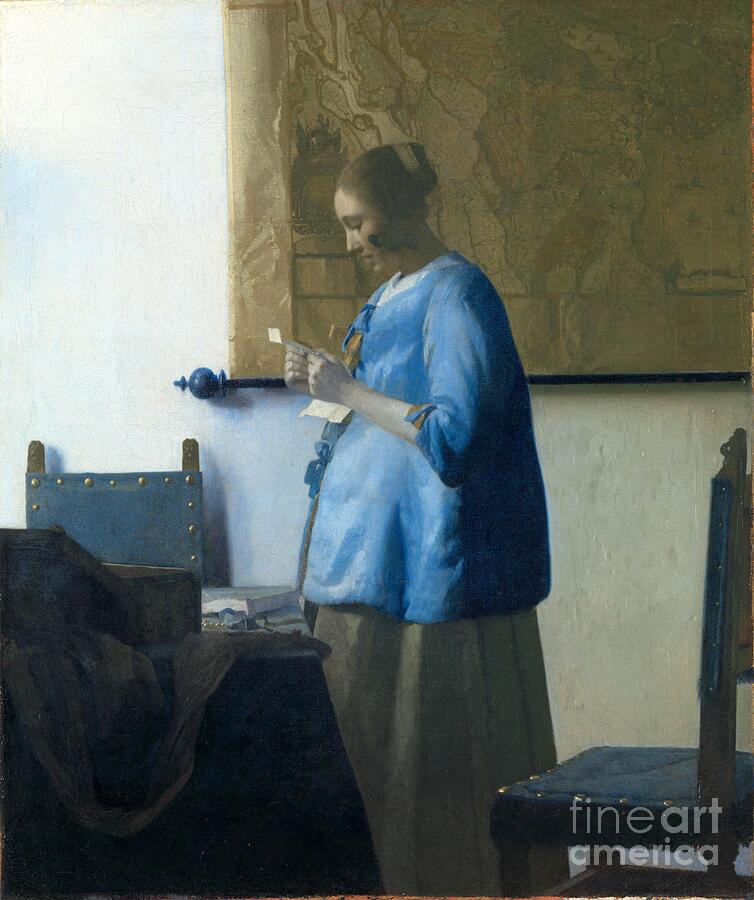
Get Vermeer's Woman Reading a Letter as a museum-quality print, canvas or poster from the Sapiens Verbum print shop.
Shop This Print →
💬 Over to you: Which art book first taught you to look at a painting, and does that printed reproduction still shape how you see the original? Tell us in the comments.
Comments
Post a Comment