1 November 1512: Michelangelo's Sistine Chapel Ceiling Is Shown to the World
On 1 November 1512, the Feast of All Saints, Rome saw Michelangelo’s finished Sistine Chapel ceiling for the first time. The frescoes had been revealed on 31 October, after some four years of work high on a scaffold, and Pope Julius II celebrated a formal papal mass in the chapel the next day. More than 300 figures, from the Creation to the prophets and sibyls, now looked down on the chapel. The picture below is our vintage poster of the ceiling’s most famous scene, The Creation of Adam; the fresco itself is shown further down.
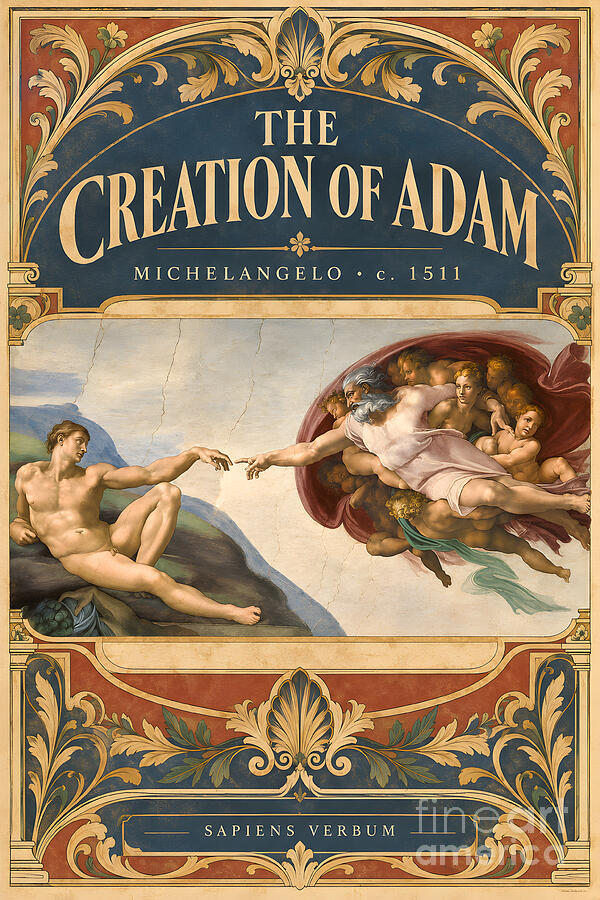
🖼️ Get the vintage poster →License this image →
What: The finished Sistine Chapel ceiling is shown to the public
When: Revealed on 31 October 1512; papal mass and public showing on 1 November 1512, the Feast of All Saints
Where: Sistine Chapel, Vatican City, Rome
Who: Michelangelo, for Pope Julius II; painted in fresco between 1508 and 1512
Section: On This Day in Art + Weekly Roundup
What happened
Michelangelo was a sculptor first, and he took on the ceiling reluctantly. He probably began planning the design in the spring of 1508, starting the painting at the west end of the chapel with the Drunkenness of Noah and working backwards through the Genesis stories towards the altar. The first half of the ceiling was shown on 14 August 1511, when Julius II held a mass in the chapel on the eve of the Assumption, its patronal feast. After a long pause while new scaffolding was put up, the second half went much faster. The whole ceiling was revealed on 31 October 1512, and on 1 November the pope celebrated mass beneath it.
According to Giorgio Vasari, the ceiling was unveiled before it could be retouched with gold, as the older wall frescoes had been. Julius wanted the gold added, but it never was; Michelangelo is said to have answered that the holy men painted there had despised wealth. Julius II died only a few months later, in February 1513.
Why it matters
The ceiling changed what painting could do. Instead of small scenes in neat frames, Michelangelo filled the vault with powerful, sculptural bodies seen from below: nine scenes from Genesis down the centre, the prophets and sibyls on their thrones along the sides, the ancestors of Christ in the lunettes and the famous nude youths, the ignudi, at the corners of the scenes. Generations of artists came to Rome to study it. Darkened by centuries of candle smoke and varnish, it was cleaned between 1980 and 1989, and the restored ceiling was unveiled by Pope John Paul II in 1994, showing again the bright colours of 1512.
The painting behind the story
The Creation of Adam is the scene everyone knows, even people who have never been to Rome. Adam lies on a bare hillside, his body perfect but still heavy and passive. God rushes towards him through the air, carried by angels inside a billowing red cloak, and stretches out his arm. Their fingers almost touch, and the tiny gap between them is the most famous empty space in art: the moment just before life passes from God to man. For the full story of the fresco, read The Creation of Adam by Michelangelo; for more Christian masterpieces, browse our Sacred Art: Paintings and Vintage Posters page.
Hang Michelangelo’s Creation of Adam — the two hands and the gap between them — as a vintage art poster from the Sapiens Verbum print shop.
 Choose your size and frame →See the religious vintage poster collection →License this image →
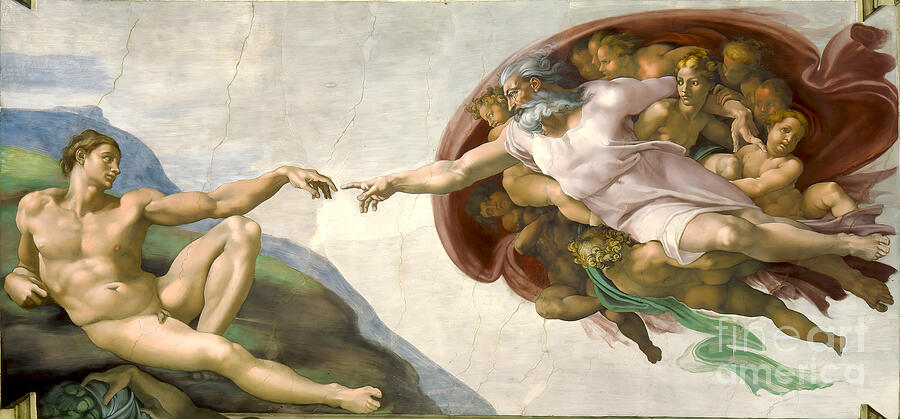
Hang the scene as Michelangelo painted it on the ceiling, as a print, canvas or framed print from the Sapiens Verbum print shop.
 Choose your size and frame →The Prophet Jeremiah from the ceiling →
Printed and shipped by Fine Art America · 30-day money-back guarantee
Also on this day
The Baroque painter and architect Pietro da Cortona was born on 1 November 1596, the sculptor Antonio Canova on 1 November 1757 and the American painter William Merritt Chase on 1 November 1849. Raphael’s pupil Giulio Romano died on 1 November 1546, and the Utrecht Caravaggist Hendrick ter Brugghen on 1 November 1629.
The week in Sapiens Verbum Daily
- Museums & Exhibitions: Artemisia Gentileschi in Florence: fifty works on her Medici years.
- Museums & Exhibitions: El Greco’s 1573 Crucifixion went on long loan to the Museo del Greco in Toledo.
- Museums & Exhibitions: El Greco’s vision of Saint Lawrence came to Madrid’s Palacio de Liria.
- Discoveries & Restorations: Van Gogh’s Starry Night matches the dawn sky of 22 July 1889, a study says.
- Museums & Exhibitions: The National Gallery will stage the largest ever Piero della Francesca exhibition in 2027.
- Museums & Exhibitions: Caravaggio comes to Parma, with the Incredulity of Saint Thomas as the finale.
💬 Over to you: If you could lie on your back under the Sistine ceiling for one hour, which scene would you look at first? And where in the world are you reading from? Tell us in the comments.
Comments
Post a Comment