Van Gogh's Starry Night Matches the Dawn Sky of 22 July 1889, Study Says
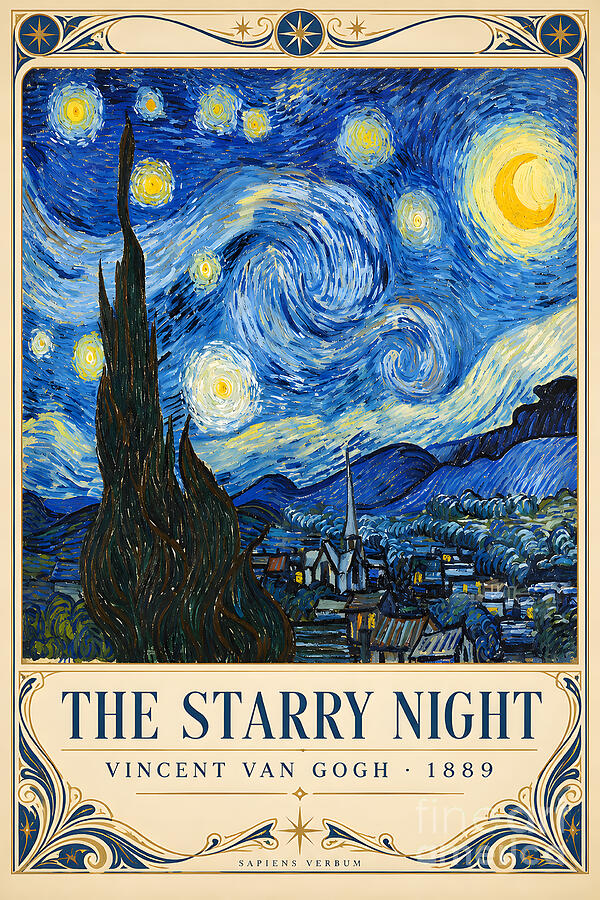
The swirling sky of Vincent van Gogh’s The Starry Night may be less imaginary than it looks. A study published on 22 October 2026 in the journal Scientific Reports argues that the crescent Moon, the bright “star” of Venus and the group of stars at the centre of the canvas match the real pre-dawn sky over Saint-Rémy-de-Provence around 22 July 1889, about a month later than the date usually given to the painting.
🖼️ Get the vintage poster →See the original as a print →
What: A new study dates the sky of The Starry Night to the dawn of about 22 July 1889
Where: Saint-Rémy-de-Provence, France; the painting is at the Museum of Modern Art, New York
When: Published 22 October 2026 in Scientific Reports
Who: Lead author Elijah Jeong-hyun Kim, Kyung Hee University and the telescope company SLLAB
Section: Discoveries & Restorations
What happened
Van Gogh painted The Starry Night in 1889 while staying at the asylum of Saint-Paul-de-Mausole in Saint-Rémy, and the canvas is usually dated to June of that year. On 18 June he told his brother Theo about “a new study of a starry sky”. Astronomers have tried to identify its sky before, among them Albert Boime and George Abell in the 1980s and later Charles Whitney, but their results did not agree.
According to ScienceAlert and Space.com, the new team travelled to Saint-Rémy twice in 2019 to photograph the scenery and estimate how narrowly the painter framed his view, using an earlier drawing connected with the village landscape. They then compared that frame with computer reconstructions of the 1889 sky. Only a few dawns put the Moon above Venus inside the frame, and around 22 July the Hyades, the V-shaped star cluster in Taurus, sat at the centre. Using a statistical shape comparison of the five central stars, the Hyades gave the closest fit of all the candidates, and the fit was even closer in a pen drawing Van Gogh made after the painting. A waning gibbous Moon in mid-June, the researchers note, does not match the slender crescent on the canvas.
The authors are careful. Other star groups also matched well, so shape alone cannot prove the identification, and Kim told the Associated Press that the days before and after 22 July could also have inspired the painter. The physicist José Luis Aragón, who was not involved, called the July date “an intriguing hypothesis rather than a settled answer”.
Why it matters
If the study is right, the most famous night sky in art began with something Van Gogh actually saw, even if he transformed it with swirling brushwork and probably combined several mornings in one picture. It also reopens the chronology of his summer in Saint-Rémy: the illness that stopped his work in July is usually placed in mid-month, and the team argues it may have begun later. Art historians who see the painting as stylistically close to his June works will want more evidence, and the authors themselves call for further research in art history and conservation science.
The painting behind the story
The Starry Night, shown at the top of this story in our vintage poster version, combines a real view and an imagined one. The Museum of Modern Art notes that the painting was based on the view from his window at the asylum, while the village came from other views and the cypress was brought closer. The bright light just left of centre is Venus, the morning star Van Gogh described in a letter to Theo. For a full guide to the painting, read our essay The Starry Night by Van Gogh: Swirls, Asylum Windows, and a Quiet Village, and for another self-searching picture from the same year, see his 1889 self-portrait in the Musée d’Orsay.
Hang Van Gogh’s Starry Night — the crescent Moon, the morning star and the swirling sky over Saint-Rémy — as a vintage art poster from the Sapiens Verbum print shop.
 Choose your size and frame →
See the vintage poster collection →
Hang The Starry Night as Van Gogh painted it, every swirl and star in place, as a print, canvas or framed print from the Sapiens Verbum print shop.
 Choose your size and frame →
Printed and shipped by Fine Art America · 30-day money-back guarantee
💬 Over to you: Now that you know the bright light may be Venus and the central stars the Hyades, does The Starry Night feel more like a real sky or still a vision? And where in the world are you reading from? Tell us in the comments.
Sources
- Space.com: Van Gogh’s The Starry Night depicts the sky on July 22, 1889, researchers find
- ScienceAlert: Van Gogh’s Starry Night and the sky of July 1889
- Associated Press (via WCAX): New study traces van Gogh’s famed Starry Night to an actual night sky from 1889
- Museum of Modern Art: Vincent van Gogh, The Starry Night
Comments
Post a Comment