Climb Up to Castagno's Last Supper: Florence Opens the Restoration Scaffold at Sant'Apollonia
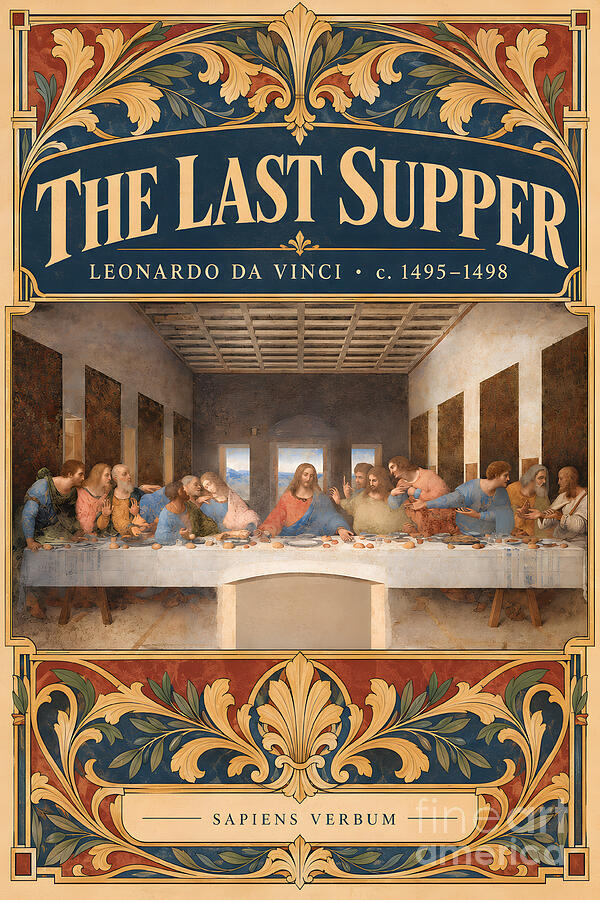
From 15 November 2026, visitors in Florence can climb a scaffold and stand a few centimetres from one of the great Last Suppers of the Renaissance. Andrea del Castagno’s fresco in the Cenacolo di Sant’Apollonia, painted around 1447 in the refectory of a convent of Benedictine nuns, is being restored, and instead of closing the room the Direzione regionale Musei nazionali Toscana has built a second scaffold for the public beside the restorers’ own. Castagno’s fresco is not in our shop, so the picture below is the most famous Last Supper of all, Leonardo’s, as our vintage poster.
🖼️ Get the vintage poster →License this image →
What: Restoration of Andrea del Castagno’s Last Supper, with a scaffold open to visitors
Where: Cenacolo di Sant’Apollonia, Via XXVII Aprile 1, Florence
When: Scaffold visits from 15 November 2026 to 26 June 2027; work began in September 2026
Who: Direzione regionale Musei nazionali Toscana, with the Opificio delle Pietre Dure; supported by the Fondazione Isabel e Balz Baechi
Tickets: Scaffold visit €8 (30 minutes, minimum age 7); museum only €3
Section: Places & Heritage
What is happening
The restoration started in September 2026. After a short closure to set up the site, the refectory has reopened with two scaffolds side by side: one for the restorers and one for visitors. According to the organisers, the aim is to make the paintings easier to read and to carry out a full scientific study of their materials, technique and earlier interventions, with the Opificio delle Pietre Dure, Florence’s state conservation institute, supporting the diagnostics. The work is coordinated by the Direzione regionale Musei nazionali Toscana of the Ministry of Culture and supported by the Fondazione Isabel e Balz Baechi, a private foundation devoted to wall paintings, stucco and mosaics.
Scaffold visits last 30 minutes and cost €8. They run from 15 November 2026 to 26 June 2027, Monday to Saturday and on the first and third Sunday of each month, from 8:30 to 13:50. Visitors must be at least seven years old and wear a helmet, and the route is not accessible to people with reduced mobility. Guided visits of the museum and the scaffold cost €10 and must be booked; the museum alone costs €3. Reports differ slightly on the guided-tour days, so check the booking page before you go.
Why it matters
Most people know the Last Supper through Leonardo, but Castagno’s version, painted about fifty years earlier, is one of the most powerful of the Florentine Renaissance. It stayed hidden for centuries behind the walls of a closed convent: Giorgio Vasari, who wrote the lives of the Renaissance artists, never mentions it, and the cycle was rediscovered only in the nineteenth century, after the convent was requisitioned for military use. The refectory opened as a museum on 1 April 1891. A restoration that lets the public see the painted surface from close up, while the work is going on, is a rare chance to look at it as the painter did.
The painting behind the story
Castagno covered the end wall of the nuns’ dining hall with the Passion of Christ. In the upper band, the Resurrection, the Crucifixion and the Entombment unfold across a single landscape; these scenes were detached from the wall in 1953, and their preparatory drawings, the sinopie, in 1961. The Last Supper below is still on its original wall. Christ and the apostles sit in a painted room lined with coloured marble panels, and Judas sits alone on the opposite side of the table, as tradition required. Leonardo, in Milan in the 1490s, broke that rule and seated Judas among the others, turning the scene from a list of figures into a moment of shock, the instant after Christ says that one of them will betray him. That is the picture above, and below as the original.
Hang Leonardo’s Last Supper in a gold and blue Art Nouveau frame, as a vintage art poster from the Sapiens Verbum print shop.
 Choose your size and frame →Religious vintage posters →License this image →
Printed and shipped by Fine Art America · 30-day money-back guarantee
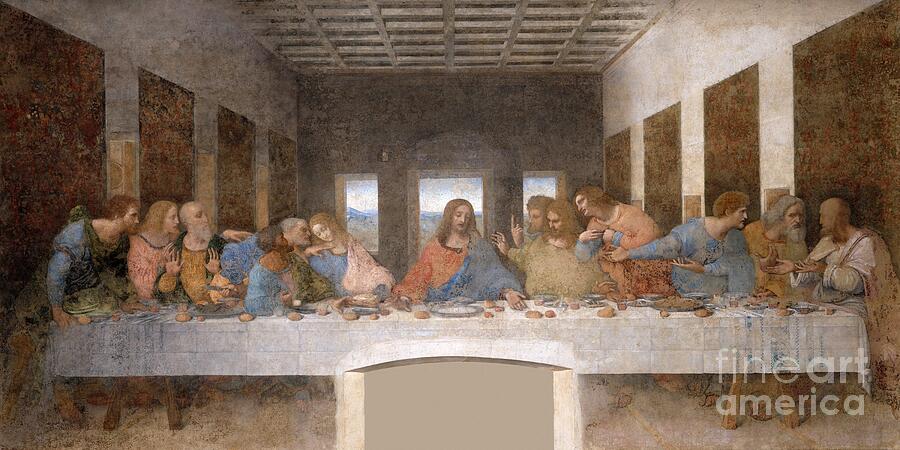
Hang Leonardo’s mural as he painted it, as a print, canvas or framed print.
Choose your size and frame →Read our essay on the Last Supper →
💬 Over to you: Would you climb the scaffold to see Castagno’s Last Supper from a few centimetres away? And where in the world are you reading from? Tell us in the comments.
Sources
- Artribune: A Firenze il Cenacolo di Sant’Apollonia di Andrea del Castagno si visita sul ponteggio di restauro (November 2026)
- La Nazione: Firenze, riapre al pubblico il Cenacolo di Sant’Apollonia durante il restauro (November 2026)
- Revenews: A tu per tu con l’Ultima Cena di Andrea del Castagno (12 November 2026)
- Wikipedia: Andrea del Castagno
Comments
Post a Comment