A Lost Georgia O'Keeffe Found Behind the Coats: Near Abiquiu, New Mexico I Heads to Christie's New York
“By the way, there’s a Georgia O’Keeffe in the closet.” With that remark to a visiting relative, an elderly woman in New York’s East Village revealed a painting that scholars had known for decades only from an old photograph. Near Abiquiu, New Mexico I, painted by Georgia O’Keeffe in 1930, had spent some forty years in its original box, behind a row of coats. On Tuesday 17 November 2026 it will be offered at Christie’s 20th Century Evening Sale in New York, with an estimate of around $3 million, and until then it is on free public view at Christie’s in Rockefeller Center.
🖼️ Get the vintage poster →License this image →
What: Georgia O’Keeffe, Near Abiquiu, New Mexico I, 1930, oil, about 25 × 61 cm
Found: In a closet of an East Village apartment, New York, earlier this year
Sale: Christie’s 20th Century Evening Sale, New York, 17 November 2026
Estimate: Around $3 million
On view: Free, at Christie’s, Rockefeller Center, until 17 November
Bought in 1963 for: $3,800, at the Downtown Gallery, Manhattan
Section: Auctions & Market
What happened
The painting’s story begins in 1963, when a New York woman bought it for $3,800 at the Downtown Gallery on 51st Street, the Manhattan gallery that represented O’Keeffe, as a present for her daughter on finishing her studies. The daughter, who went on to a career in the US Foreign Service and has been described by her family as private, accomplished and a gifted bridge player, hung it in her apartment until the mid-1980s. Then, according to the family’s account given by Christie’s, she noticed a guest looking at it a little too closely. Unsettled, she packed it back into the gallery’s original wooden box and put it away in the entrance closet, behind the coats. Nobody else in the family knew it was there.
Earlier this year, while a relative was helping her sort out her belongings, she casually mentioned the O’Keeffe in the closet. The box was found where she said it would be, photographs were sent to Christie’s, and its specialists began examining the work, which is marked “OK” on the back of the panel. The owner died shortly afterwards. Until now the picture had been known only from a photograph taken in 1931 and a mention in the appendix of the artist’s catalogue raisonné.
Why it matters
O’Keeffe first travelled to New Mexico in 1929, and the landscape of hills, mesas and desert light became one of the great subjects of her life. Painted a year later, Near Abiquiu, New Mexico I shows Lobo Peak, north of Taos, and is probably the first of three views of the mountain. The second is in the Metropolitan Museum of Art in New York; the third is in a private collection and once belonged to David and Peggy Rockefeller. Finding the first of the series is a small but real addition to the history of American modernism. Christie’s Tylee Abbott calls it a “once-in-a-lifetime” opportunity: rediscoveries are rare for a historic American artist as thoroughly studied as O’Keeffe.
The O’Keeffe is one of the stories of New York’s November “Marquee Week”. The next evening, 18 November, Sotheby’s offers the Blaquier-Arrieta collection, led by Van Gogh’s Chestnut Trees in Flower and Cézanne’s Harlequin, two more pictures that had been out of public view for half a century.
The painting behind the story
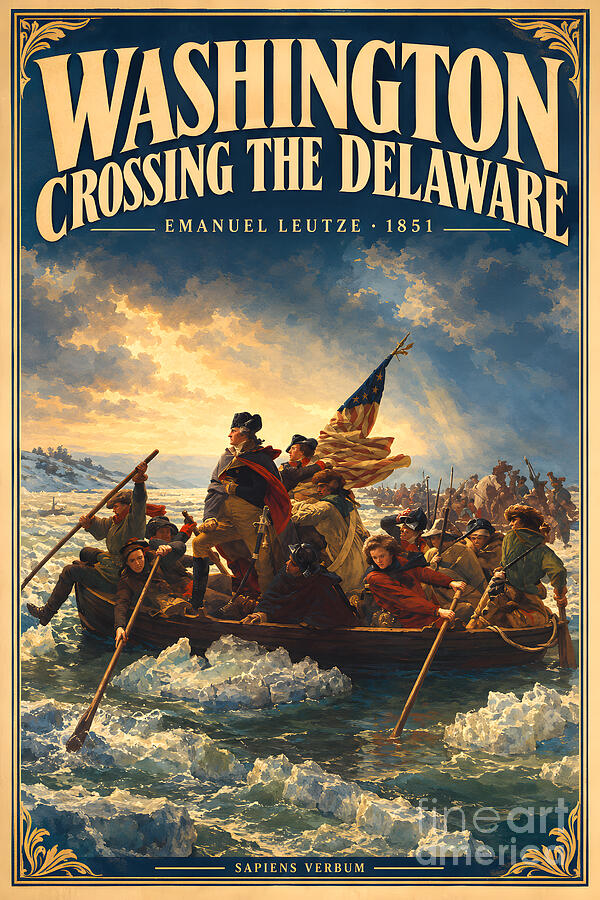
Emanuel Leutze painted Washington Crossing the Delaware in Germany in 1851. It shows George Washington crossing the icy river before his attack on the German mercenaries at Trenton, New Jersey, on 25 December 1776, a turning point in the War of Independence. Almost 4 by 6.5 metres, it was a huge success in both the United States and Germany, and in spite of its historical inaccuracies it remains one of the most famous and most reproduced American paintings. It belongs to the American Wing of the Met, the same museum that keeps O’Keeffe’s second view of Lobo Peak. For a famous painting that turned up in an unexpected place, read A Lost Caravaggio Found in Paris?; and for a painting recovered after decades, see Wanted Posters Work: Orléans Museum Recovers a Duyster Painting Lost in 1940.
Hang Leutze’s Washington Crossing the Delaware — the ice, the oars and the flag on a winter dawn — as a vintage art poster from the Sapiens Verbum print shop.
 Choose your size and frame →
See the vintage poster collection →License this image →
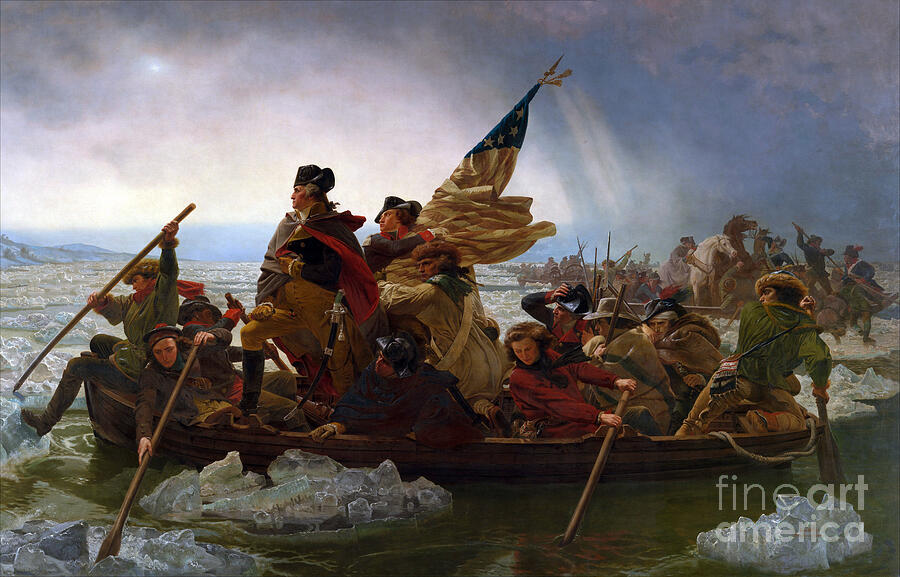
Hang Leutze’s great history painting as he painted it, as a print, canvas or framed print from the Sapiens Verbum print shop.
 Choose your size and frame →Cézanne’s Harlequin as a poster →
Printed and shipped by Fine Art America · 30-day money-back guarantee
💬 Over to you: Would you have kept a painting hidden in the closet for forty years, or hung it on the wall and taken the risk? And where in the world are you reading from? Tell us in the comments.
Sources
- Finestre sull’Arte: A Georgia O’Keeffe painting hidden away for decades has been rediscovered (8 November 2026)
- Hyperallergic: Long-Lost Georgia O’Keeffe Landscape Goes to Auction (5 November 2026)
- Galerie: A Long-Lost Georgia O’Keeffe Painting Is Rediscovered in a Manhattan Closet (6 November 2026)
- The Daily Beast: Lost $3 Million Georgia O’Keeffe Painting Found in Closet (5 November 2026)
- The Metropolitan Museum of Art: Emanuel Leutze, Washington Crossing the Delaware
Comments
Post a Comment