8 November 1674: John Milton Dies, and Paradise Lost Passes to the Painters
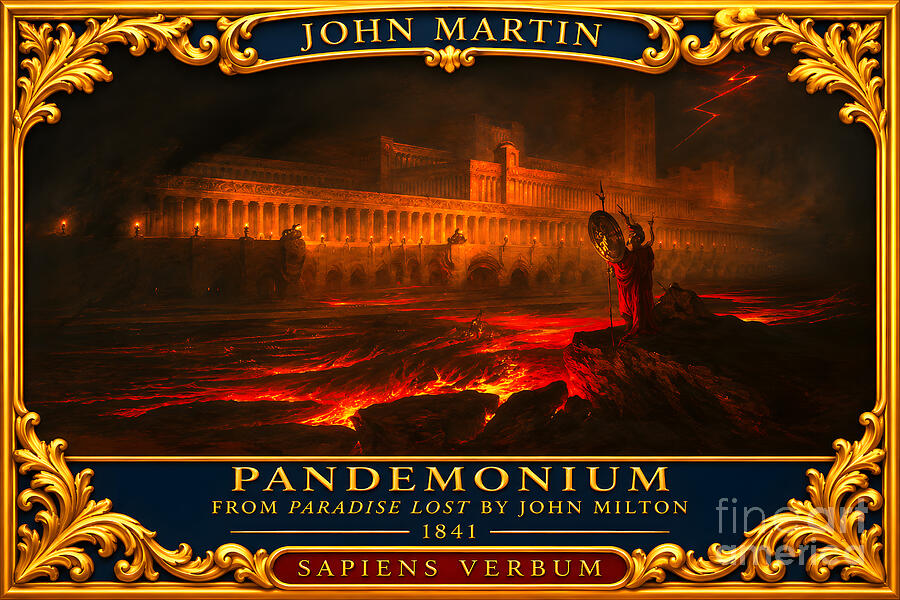
On 8 November 1674, John Milton died in London, blind, poor and politically out of favour. He left behind Paradise Lost, the epic of Satan’s fall and of Adam and Eve’s expulsion from Eden, and for the next two centuries painters returned to it again and again. One of the most spectacular of them was John Martin, whose vision of Pandemonium, the capital of Hell, now hangs in the Louvre. The picture below is our vintage poster of that painting; the original is shown further down.
🖼️ Get the vintage poster →License this image →
What: Death of the poet John Milton, author of Paradise Lost
When: 8 November 1674
Where: Artillery Walk, off Bunhill Fields, London; buried at St Giles-without-Cripplegate
Who: John Milton (1608–1674), English poet, blind since about 1652
Section: On This Day in Art + Weekly Roundup
What happened
Milton was born in Bread Street, in the City of London, on 9 December 1608. A republican who had served Oliver Cromwell’s government as Secretary for Foreign Tongues, he had good reason to keep his head down after the return of Charles II in 1660. By 1652 he had gone completely blind, so he composed Paradise Lost in his head and dictated it to helpers. On 27 April 1667 he sold the rights to the publisher Samuel Simmons for £5, with a further £5 promised for each print run that sold out. The poem appeared that August in ten books.
Just before his death, Milton saw a second edition through the press, now divided into twelve books, with prefatory verses by his friend Andrew Marvell. He died on 8 November 1674 at his house in Artillery Walk, off Bunhill Fields, a poor district on the northern edge of the City; whether the cause was consumption or gout is disputed. He was buried in the nearby church of St Giles-without-Cripplegate, where a bust and a statue now remember him.
Why it matters
Paradise Lost gave artists something the Bible alone did not: a full story, with landscapes, armies of angels, a palace in Hell and a Satan who is proud, eloquent and almost heroic. From the late eighteenth century, painters and illustrators competed to picture it. Henry Fuseli painted a whole series of Milton subjects, William Blake made watercolours for the poem, John Martin produced a famous set of mezzotints in the 1820s, and in 1866 Gustave Doré published the engravings that fixed its images for generations of readers. Milton even gave the language a new word: “Pandaemonium”, the council hall of all the demons.
The painting behind the story
In Book I of the poem, the fallen angels raise their capital out of the burning ground in a single hour: “Anon out of the earth a fabric huge / Rose like an exhalation”. John Martin had already engraved the scene twice, and in 1841 he painted it on a grand scale for the Royal Academy, with those very lines in the catalogue. Satan stands on a rock in the right foreground, holding his spear and shield. Before him, a palace with endless columns glows across a lake of fire, its classical architecture closer to a grand public building of Martin’s own day than to any medieval Hell. Martin even designed the frame himself, decorated with snakes and dragons, and he showed the picture with a companion of Heaven, The Celestial City and the River of Bliss. Pandemonium was acquired by the Louvre in 2006. For another painter’s vision of the lost Eden, read our essay on The Lost Paradise by Eduard Kasparides.
Hang John Martin’s Pandemonium — the fiery lake, the endless palace and Satan on his rock — as a vintage art poster from the Sapiens Verbum print shop.
 Choose your size and frame →See the vintage poster collection →License this image →
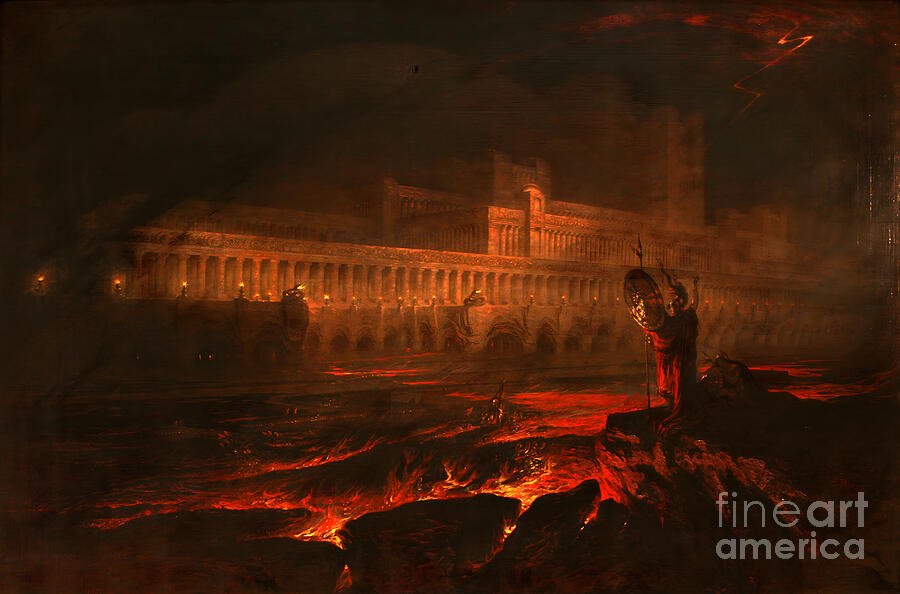
Hang Martin’s vision of Hell as he painted it, as a print, canvas or framed print from the Sapiens Verbum print shop.
 Choose your size and frame →Doré’s Paradise Lost engraving →
Printed and shipped by Fine Art America · 30-day money-back guarantee
Watch the video essay on @SapiensVerbum on YouTube.
Also on this day
The Renaissance painter Melozzo da Forlì died on 8 November 1494, the English wood engraver Thomas Bewick on 8 November 1828 and the American illustrator Norman Rockwell on 8 November 1978. On 8 November 2017, the Louvre Abu Dhabi was inaugurated by the French president Emmanuel Macron.
The week in Sapiens Verbum Daily
- Museums & Exhibitions: Liaisons françaises: Munich’s Alte Pinakothek shows its French paintings, from Claude Lorrain to Boucher.
- Discoveries & Restorations: Borromini’s Sant’Ivo alla Sapienza reopened in Rome after restoration, free to visit.
- Museums & Exhibitions: A triptych damaged in the 1966 flood returned to view at Florence’s Accademia.
- Law & Restitution: Wanted posters work: the Orléans museum recovered a Duyster painting lost in 1940.
- Places & Heritage: Versailles has a new president, the former Christie’s chief Guillaume Cerutti.
- Books & Ideas: A forgotten golden age: a new book maps French landscape painting under Louis XIV.
💬 Over to you: Which picture of Paradise Lost stays with you: Martin’s fiery Hell, Doré’s engravings or Blake’s watercolours? And where in the world are you reading from? Tell us in the comments.
Comments
Post a Comment