William Morris's Teenage Home Reopens: Walthamstow Gallery Unveils a Radical Rehang
The house where William Morris spent his teenage years reopens to the public on Saturday, 3 October 2026. The William Morris Gallery in Walthamstow, east London, closed for the summer for its first major rehang since 2012, and returns with six transformed rooms, objects never shown before and a new opening exhibition, Earthly Paradise: Radical Living in the UK, according to The Art Newspaper and Time Out London.
What: Reopening of the William Morris Gallery after a rehang and restoration
Where: Water House, Lloyd Park, Forest Road, Walthamstow, London E17
When: Reopens 3 October 2026; Earthly Paradise runs to 28 March 2027
Who: Waltham Forest Council's gallery, director Hadrian Garrard, with designers Sam Jacob Studio
Section: Places & Heritage
What happened
The Art Newspaper reports that the project cost about £1.5 million, funded by the Garfield Weston Foundation, the Wolfson Foundation and Waltham Forest Council. Six gallery spaces have been reworked, with colour used to bring out the architectural details of the Georgian house and a more domestic feel throughout. Time Out says the new layout, designed with Sam Jacob Studio, puts more weight on stories that were previously overlooked: the women of the Arts and Crafts movement, the South Asian and Islamic sources of Morris's patterns, and the life of his ideas today.
Both reports single out the banner Morris made for the Hammersmith Socialist League, shown in public for the first time; Time Out also mentions his own copy of One Thousand and One Nights. The Art Newspaper adds embroidery designs by his daughter May Morris, books that belonged to his daughter Jenny, a lock of Morris's hair and a room that sets his socialist politics against the luxury goods his firm sold. A further space, Morris Today, is due to open in 2027 for contemporary artists responding to his work. Entry to the gallery is free, Tuesday to Sunday, 10am to 5pm.
Why it matters
Water House is not a neutral white box. Built in 1762, it was the Morris family home from 1848 to 1856, the years when the teenage William roamed Epping Forest and filled his head with the medieval world that would shape everything he made. The council turned it into a museum in 1950, when it was opened by the Prime Minister Clement Attlee, a fitting choice for a gallery devoted to a designer who was also a committed socialist.
That tension, between Morris the maker of beautiful and expensive things and Morris the revolutionary who wanted beauty for everyone, is exactly what the new rooms are built around. It is also why the gallery matters to anyone who loves Pre-Raphaelite painting. Morris was at the heart of that circle: a lifelong friend of Edward Burne-Jones, a partner of Dante Gabriel Rossetti in the decorative firm founded in 1861, and the husband of Jane Burden, whose face became one of the defining images of the movement.
The painting behind the story
Jane Morris sat for Rossetti again and again, and his Proserpine of 1874, now at Tate Britain, is the most famous result. She plays the queen of the underworld, holding the pomegranate whose seeds bound her to Hades for half of every year. Rossetti returned to the subject in several versions. The Tate canvas is not part of the Walthamstow display, but it is the closest work in our shop to the people whose house has just reopened.
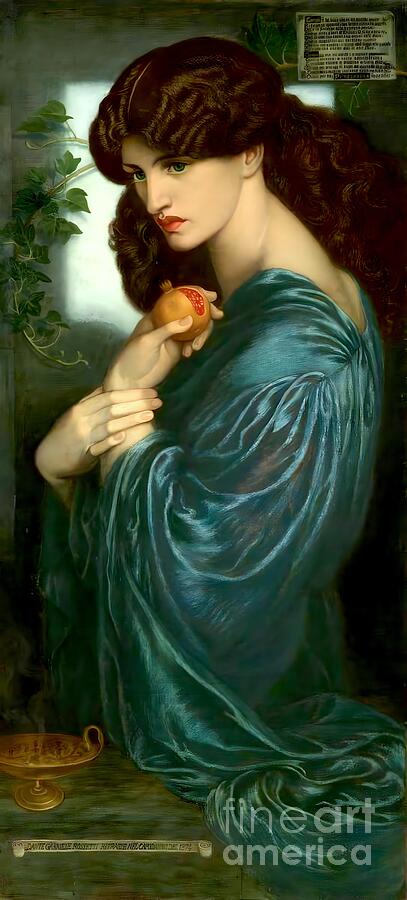
🖼️ Get this painting as a print →
For the wider story of the movement, read our essay Pre-Raphaelitism in Painting: The Movement That Defied Convention, and see how the next generation carried the style on in every Waterhouse painting we have explained.
See Rossetti’s Proserpine framed on your wall: a museum-quality print, canvas or poster from the Sapiens Verbum print shop.
 Choose your size and frame →
Printed and shipped by Fine Art America · 30-day money-back guarantee
💬 Over to you: Which side of William Morris interests you more, the designer of wallpapers and books or the socialist who wanted art for everyone, and why? Tell us in the comments.
Sources
The Art Newspaper, 30 September 2026
Time Out London
William Morris Gallery, visitor information
Wikipedia, "William Morris Gallery"
Comments
Post a Comment