Turner's Unrestored View of Rome Could Break Its Own Auction Record at Sotheby's
For three days last week, a painting of Rome went home to Rome. J.M.W. Turner’s Rome, from Mount Aventine, first exhibited at the Royal Academy in London in 1836, was unveiled by Sotheby’s at the Palazzo Rondinini on 29 September 2026 and stayed on view until 1 October, as The Art Newspaper, The Guardian and ARTnews reported. It now heads for the Old Master & 19th Century Paintings Evening Auction in London on 9 December, where it is expected to fetch around £50 million ($66.2 million). If it does, the canvas will break the Turner auction record that it set itself in 2014.
What: J.M.W. Turner’s Rome, from Mount Aventine (exhibited 1836), oil on unlined canvas, 92.7 × 125.7 cm, leading Sotheby’s Old Master & 19th Century Paintings Evening Auction at an estimate of about £50 million
Where: Shown at the Palazzo Rondinini, Rome; then Sotheby’s in London, Hong Kong and New York; auction at Sotheby’s London
When: On view in Rome 29 September–1 October 2026; auction 9 December 2026
Who: Consigned by “a distinguished private collection”, the buyer at Sotheby’s in 2014; Julian Gascoigne, senior specialist in British paintings, and Mario Tavella, chair of Sotheby’s Europe
Section: Auctions & Market
What happened
Sotheby’s chose an 18th-century baroque palace built by an art collector for the unveiling, and according to the auction house the three-day show made Rome, from Mount Aventine the most valuable work an auction house has ever exhibited in Italy, The Art Newspaper reports. The tour continues in London, then Hong Kong, where Sotheby’s notes high interest in Turner among Asian clients, and New York, before the picture returns to the New Bond Street galleries ahead of the December sale. On Sotheby’s own lot page the estimate is listed as “upon request” and the work is marked as guaranteed property.
The figure to beat is the painting’s own. On 3 December 2014, when the Rosebery family sold it at Sotheby’s London, four bidders pushed it to £30.3 million with fees against an estimate of £15 million–£20 million, The Guardian reported at the time; it was then the highest price for any pre-20th-century British artist at auction, and it remains Turner’s record. “I could count on one hand the number of late, great [Turner] masterpieces in private hands,” Gascoigne told The Art Newspaper. “In the twelve years since this painting has last come to auction, there has been no Turner of its calibre on the market.” He added that “there is also every chance that an institution might want to enter the fray”, and Tavella told reporters in Rome that he hoped a public museum would buy it, “where it could be admired by everyone”.
Why it matters
Rarity is only half the pitch; condition is the other. In almost 200 years the canvas has never been relined or restored, and it is still on its original canvas and in its original frame. Turner’s fingerprints, the scrapes of his palette knife and individual hairs from his brushes are visible in the paint. “You can see all the delicate glazes of translucent paint that he’s built up over successive painting sessions that give the picture this extraordinary sense of light and depth and glow,” Gascoigne told The Guardian.
The painting was commissioned in the late 1820s by Hugh Andrew Johnstone Munro of Novar, an amateur artist who went with Turner on sketching tours and who, by the time his collection was sold, was described as Turner’s “intimate friend and Executor”. Turner, who had visited Rome in 1819 and again in the late 1820s, began the picture in Italy and finished it in London. It drew mixed reviews at the Royal Academy in 1836, although the Morning Post called it “one of those amazing pictures by which Mr Turner dazzles the imagination and confounds all criticism: it is beyond praise”. According to Sotheby’s provenance, it was sold at Christie’s on 6 April 1878 for 5,850 guineas to an agent bidding for Archibald Primrose, 5th Earl of Rosebery, and his wife Hannah de Rothschild; The Art Newspaper describes it as a wedding gift for the marriage of the future prime minister to the wealthiest woman in Britain. The Roseberys kept it for 136 years, lending it to the National Gallery of Scotland from 1978 to 2013.
Gascoigne also makes an art-historical case. “This is the only painting by the artist of Rome as it looked during his time,” he told reporters. “Every other painting he did of Rome was an evocation of a bygone age. But this is the only portrait of the city. In many ways, it’s his great love letter to the city that inspired him throughout his life.”
The painting behind the story
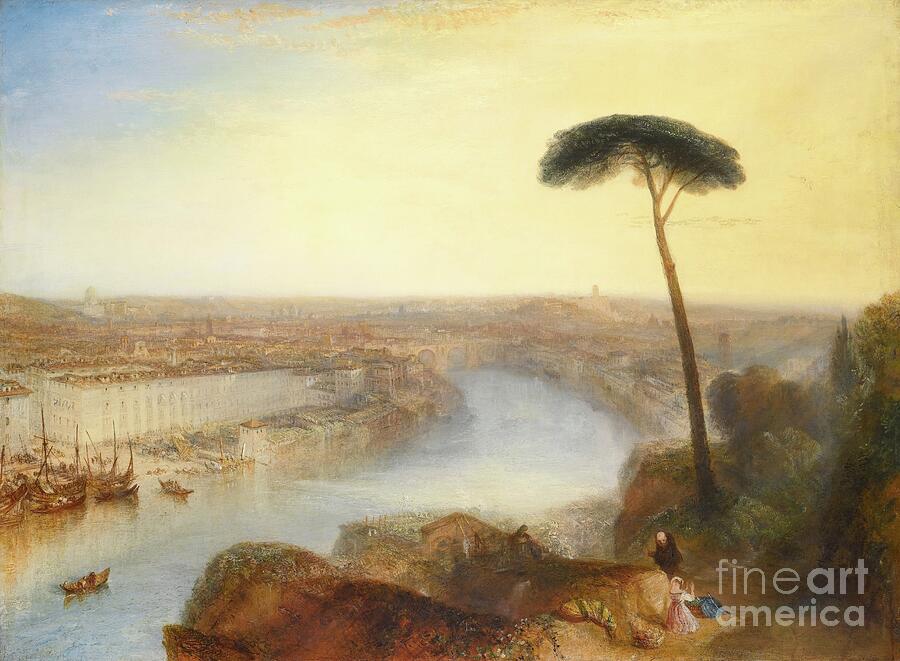
This is the canvas itself. Turner looks down from the Aventine Hill as the Tiber winds away from us under a bridge into a city dissolved in gold. On the left, sailing boats crowd the bank below a long pale building; on the right, a single umbrella pine shoots up into an almost white sky, its dark crown the sharpest thing in the picture. In the foreground, a few tiny figures rest on the slope with their baskets, and the whole of Rome stretches out behind them to a dome on the far horizon, softened by haze and light.
The sky does most of the work: blue at the top left, it melts into a warm yellow glow that seems to come from inside the painting rather than from the sun. That is the effect Gascoigne credits to layer upon layer of translucent glazes, kept intact because the canvas was never lined, and the source of the “astonishing freshness” Sotheby’s claims for it.
🖼️ Get this painting as a print →
For another Turner that never left public view, read our essay The Fighting Temeraire by J.M.W. Turner: The Last Voyage of a Trafalgar Hero, and for the other record contender of the autumn season, see how Van Gogh’s long-hidden chestnut trees could smash his auction record at Sotheby’s.
See Turner’s Rome, from Mount Aventine framed on your wall: a museum-quality print, canvas or poster from the Sapiens Verbum print shop.
 Choose your size and frame →
Printed and shipped by Fine Art America · 30-day money-back guarantee
💬 Over to you: Sotheby’s European chairman hopes a museum will buy it. Should a Turner that spent 35 years on loan to the National Gallery of Scotland end up back on public walls, or is a record price the fairer test of its worth? Tell us in the comments.
Sources
The Art Newspaper, 29 September 2026
The Guardian, “JMW Turner’s ‘great love letter’ to Rome makes brief return to city before UK auction”, 29 September 2026
ARTnews, 29 September 2026
Sotheby’s, Joseph Mallord William Turner, R.A., Rome, from Mount Aventine (lot page)
The Guardian, Turner’s Rome, From Mount Aventine sets £30.3m record, 3 December 2014
Comments
Post a Comment