The Städel Buys Guido Reni's Only Surviving Roman Portrait: Cardinal Sannesi, 1609
The Städel Museum in Frankfurt has bought a portrait that Guido Reni painted in Rome in 1609: Portrait of Cardinal Giacomo Sannesi, a half-length of a churchman who had risen from a humble family in the Marche to the College of Cardinals. Art History News reported the purchase on 8 October 2026. The picture came from Christie’s New York Old Masters sale in June, where it was offered as the only surviving portrait from Reni’s first Roman period.
🖼️ Get this painting as a print →
What: Guido Reni, Portrait of Cardinal Giacomo Sannesi, recorded in the painter’s account book in 1609
Where: Städel Museum, Frankfurt am Main
When: Bought at Christie’s New York in June 2026; reported on 8 October 2026
Who: Guido Reni (1575–1642); the sitter, Cardinal Giacomo Sannesi (c. 1557/60–1621)
Section: Museums & Exhibitions
What happened
The portrait was one of the leading Italian lots of Christie’s Old Masters and 19th Century Paintings sale in New York in early June. The catalogue presented it as the only surviving portrait from Reni’s first Roman period. The Städel was the buyer, and the picture now carries a museum label. No price has been published. The Italian art magazine About Art Online and Art History News both reported the acquisition this week.
According to the label, the canvas is the earliest documented work of Reni’s Roman years, because his account book records it as painted in 1609. The cardinal is shown in the traditional dress of his rank: a long white rochet and the short pink cape called a mozzetta. The museum singles out the head and, above all, the eyes, which hold the whole of what it calls a laconic but expressive portrait.
Why it matters
Reni is remembered for altarpieces, myths and saints with their eyes turned to heaven. He painted very few portraits, and from his thirteen years in Rome, 1601 to 1614, this is, according to Christie’s, the only one known to survive. Those were the years in which he met Caravaggio, worked for a while among the first painters to follow his dark manner, and then became the favourite painter of Pope Paul V and Cardinal Scipione Borghese, for whom he painted the Aurora fresco now in the Palazzo Pallavicini Rospigliosi. A portrait from that moment shows how he looked at a living face before the idealised heads made him famous.
The sitter makes the picture more interesting still. Giacomo Sannesi was born to a very modest family at Belforte del Chienti, studied law, and rose in the household of Cardinal Pietro Aldobrandini until Clement VIII gave him the red hat in 1604. He collected seriously. He is the cardinal who bought the canvases Caravaggio painted for the Cerasi Chapel in Santa Maria del Popolo after they were turned down, though historians still argue about whether what he owned were the originals. He also bought from Orazio Gentileschi. Reni painted a man who knew exactly what good painting was.
For Frankfurt it closes a circle. The Städel already owned Reni’s Christ at the Column (1604) and, since 2014, an early Assumption of the Virgin on copper. In 2022–2023 it staged Guido Reni. The Divine with the Prado, where his own account book for 1609–1612, lent by the Morgan Library, was shown in public for the first time. The book that dates the new portrait is the same one.
The painting behind the story
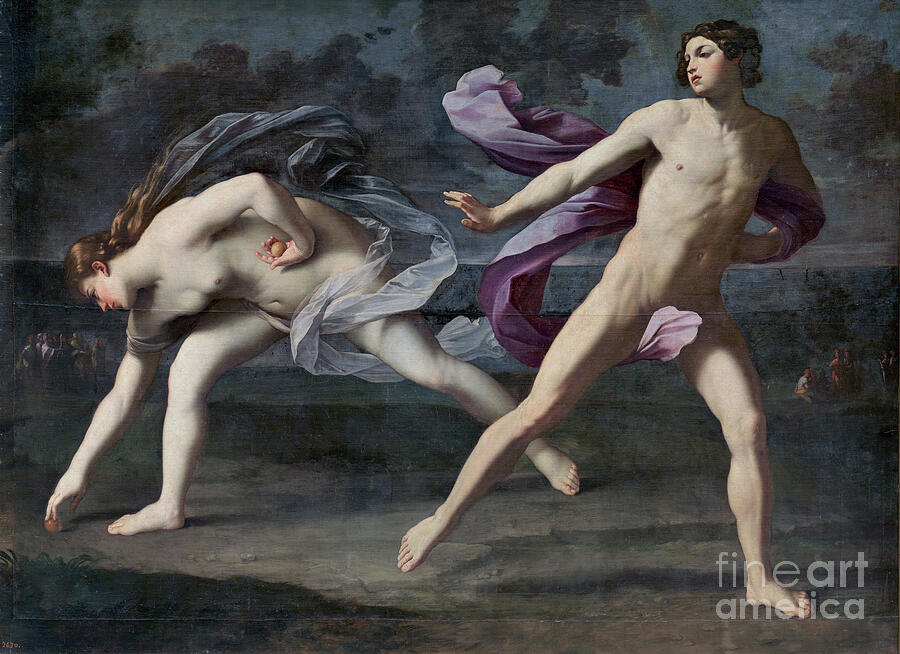
The Sannesi portrait is not in the print shop, and its photographs belong to the auction house and the museum. Our Reni is the one above: Atalanta and Hippomenes, painted around 1618–1619, after he had left Rome for Bologna. Two runners, one golden apple and a diagonal that cuts the canvas in half. It is everything the cardinal’s portrait is not: no face looks at you, and the bodies are as smooth as antique marble. Read the full story of the race, and of the years the painting spent hidden in a storeroom for pictures judged obscene, in Atalanta and Hippomenes by Guido Reni.
Bring Guido Reni’s Atalanta and Hippomenes to your wall: a museum-quality print, canvas or poster from the Sapiens Verbum print shop.
 Choose your size and frame →
Printed and shipped by Fine Art America · 30-day money-back guarantee
💬 Over to you: Reni left only one portrait from his Roman years, of a cardinal who also collected Caravaggio. What do you think a painter learns from a sitter who knows more about painting than most? Tell us in the comments.
Sources
Art History News — Guido Reni acquired by Städel Museum, 8 October 2026
About Art Online — Il Ritratto del cardinale Sannesi (1609) acquisito dallo Städel Museum
Christie’s — Guido Reni, Portrait of Cardinal Giacomo Sannesi, Old Masters and 19th Century Paintings, New York, June 2026
Städel Museum — Guido Reni. The Divine, press kit, 2022
Städel Museum — acquisition of Reni’s Assumption of the Virgin, January 2015
Wikipedia — Giacomo Sannesio
Comments
Post a Comment