'I Am Such a Lazybones': Monet's Life in 420 Letters, a Century After His Death
“I am such a lazybones when it comes to writing,” Claude Monet confessed to the critic Théodore Duret in December 1880. Yet more than 3,200 of his letters survive. A new book, Claude Monet: A Life in Letters, published by Thames & Hudson for the centenary of the painter’s death, gathers around 420 of them, written to 93 people between the age of eighteen and the end of his life. The Art Newspaper reviewed it on 8 October 2026.
🖼️ Get this painting as a print →
What: Claude Monet: A Life in Letters, about 420 letters to 93 correspondents, with profiles, introductions and notes; 552 pages, 156 colour illustrations
Where: Thames & Hudson (London and New York); US edition on 10 November 2026
When: Reviewed by The Art Newspaper on 8 October 2026; Monet died on 5 December 1926
Who: Edited by Teresa Krasny, Frances Fowle, Flavie Durand-Ruel Mouraux, Karen Serres and Sylvie Patry
Section: Books & Ideas
What happened
The editors chose the letters from more than 3,200 already transcribed in Daniel Wildenstein’s catalogue raisonné (1974–91), adding letters that had not been recorded before. The largest groups went to his dealer Paul Durand-Ruel and to Alice Hoschedé, who became his second wife. According to The Art Newspaper, they range from the despair of February 1886, when Alice proposed a separation and Monet wrote that the painter in him was dead, to gossip about Édouard Manet at work on a picture for the Salon.
The last chapters follow his gift to France. On 12 November 1918, the day after the Armistice, Monet wrote to his friend Georges Clemenceau offering two of his great water-lily decorations to the nation. By October 1921 he was refusing the gallery he had been offered at the Jeu de Paume and holding out for the Orangerie, with building works done to his own design. The editors Teresa Krasny and Karen Serres will present the book at the National Gallery in London on 23 October.
Why it matters
Monet is usually imagined as the painter who never stopped looking: at haystacks, at cathedrals, at his pond. The letters show the cost: worries about money, a family life that nearly fell apart, and the long, stubborn negotiations behind his late work. They also show his loyalty. After Manet’s death he launched a subscription for 20,000 francs so that the French state could acquire Olympia, the nude that had caused a scandal in 1865. That campaign is one reason the painting hangs in Paris today.
And they explain the Orangerie. The two oval rooms where the water lilies wrap around the visitor were not a museum’s idea but Monet’s. He fought for the light, the walls and the setting, and he did not live to see them: the rooms opened in 1927, a few months after his death.
The painting behind the story
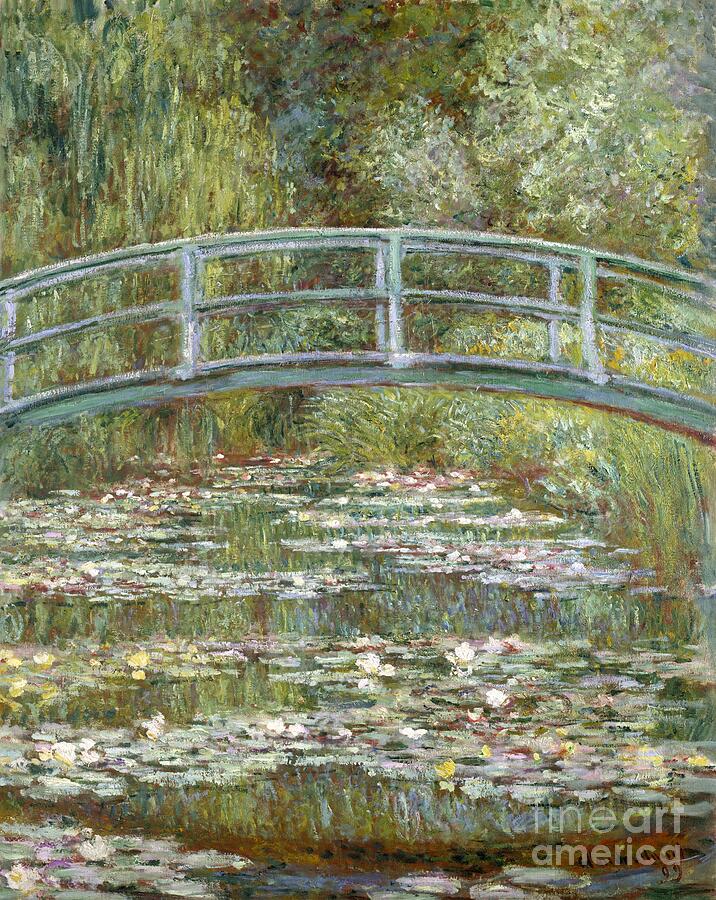
Every letter about the water lilies goes back to one place: the pond he dug at Giverny in the 1890s and spanned with a green Japanese bridge. Bridge over a Pond of Water Lilies, painted in 1899 and now in the Metropolitan Museum of Art, is one of the first pictures he made of it, still with the bridge, the banks and the willows in view. Twenty years later the bridge would disappear and only the water would be left, in the panels he gave to France. For Monet in London, see our essay on The Houses of Parliament, Sunset, and for the Orangerie itself, our Paris museum guide.
Bring Monet’s garden at Giverny to your wall: Bridge over a Pond of Water Lilies as a museum-quality print, canvas or poster from the Sapiens Verbum print shop.
 Choose your size and frame →
Printed and shipped by Fine Art America · 30-day money-back guarantee
💬 Over to you: If you could read the letters behind one painting by Monet, which painting would you choose, and what would you want to learn from them? Tell us in the comments.
Sources
The Art Newspaper — ‘I am such a lazybones’: New book reveals Claude Monet’s life through his letters, 8 October 2026
Thames & Hudson — Claude Monet: A Life in Letters
The National Gallery — Claude Monet: A Life in Letters, 100 years of legacy, 23 October 2026
The Metropolitan Museum of Art — Bridge over a Pond of Water Lilies
Comments
Post a Comment