Gentile Bellini's Procession in St Mark's Square Emerges From a Six-Year Restoration in Venice
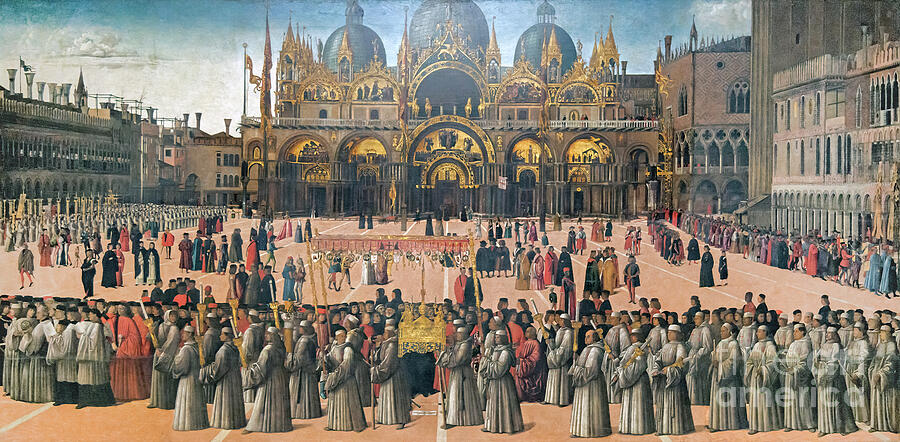
After six years in the conservation studio, three of the most famous views of Renaissance Venice are back on the walls of the Gallerie dell’Accademia. On 29 September 2026 the museum presented the first three restored canvases of the Miracles of the True Cross cycle, led by Gentile Bellini’s monumental Procession in St Mark’s Square (1496), as the museum itself, ANSA, Il Giornale dell’Arte and Finestre sull’Arte reported. Cleared of yellowed, oxidised varnish, the paintings have recovered what the museum calls the luminosity of their colours, their depth of perspective and the details of a Venice that no longer exists.
🖼️ Get this painting as a print →
What: Restoration of three canvases from the Miracles of the True Cross cycle: Gentile Bellini’s Procession in St Mark’s Square (1496, oil on canvas, 373 × 745 cm) and Miracle of the Relic of the Cross at the San Lorenzo Bridge (1500), and Vittore Carpaccio’s Miracle of the Relic of the Cross at the Rialto Bridge (1496)
Where: Gallerie dell’Accademia, Room XX, Venice; restored at the museum’s Laboratori della Misericordia
When: Work carried out 2020–2026; restored canvases presented on 29 September 2026; the remaining five canvases to be restored in public view from spring 2027
Who: Gallerie dell’Accademia (director Giulio Manieri Elia), CBC Conservazione Beni Culturali (coordinator Caterina Barnaba), funded by Save Venice Inc.
Section: Discoveries & Restorations
What happened
The eight-canvas cycle was painted between 1496 and 1500 for the Scuola Grande di San Giovanni Evangelista, one of Venice’s great lay confraternities, to celebrate a relic of the True Cross given to it in 1369 by Philippe de Mézières, grand chancellor of Cyprus. Gentile Bellini coordinated the project, with contributions from Vittore Carpaccio, Lazzaro Bastiani, Giovanni Mansueti and Benedetto Diana. “There is no other painting cycle in the world,” the museum says, that gives “such a vivid snapshot of Venice between 1496 and 1500”: a true “photograph” of the city, its people and buildings that have since vanished.
According to ANSA, the restoration began in 2020 with Carpaccio’s canvas and moved on to the two Bellinis in 2022. It was carried out by the CBC Conservazione Beni Culturali cooperative under the museum’s direction and paid for by Save Venice. Moving the paintings was a feat in itself: Il Giornale dell’Arte reports that the huge canvases were rolled onto large cylinders, taken to the laboratory and brought back the same way. Non-invasive tests, including infrared reflectography, UV fluorescence and X-ray fluorescence, guided the cleaning. “Infrared reflectography allowed us to document the underdrawing and so understand the technique and the creative process,” Barnaba told the paper. The pictures carried oxidised varnishes and retouching, the last from a 1990s intervention by the restorer Ottorino Nonfarmale.
Why it matters
These are documents as much as devotional paintings. Finestre sull’Arte points out that the cleaning of Bellini’s Miracle at the San Lorenzo Bridge has brought back the palaces along the canal with their façades entirely covered in frescoes, decoration that no longer survives anywhere in the city, and that the same canvas includes Caterina Cornaro, Queen of Cyprus, with her ladies. In Carpaccio’s Miracle at the Rialto Bridge, where the Patriarch of Grado heals a possessed man in a loggia, the old wooden Rialto Bridge spans the Grand Canal, and infrared analysis has revealed the perspective grid and vanishing point the painter laid down.
The project is not over. From spring 2027, the other five canvases will be restored one at a time inside Room XX itself, in a workshop open to visitors, so that the public can watch the conservators at work while the three finished paintings stay on view. “Every nuance, every microstratum, every minute detail brought to light by the restoration not only restores material and color but also reveals a fragment of our history,” said the mayor of Venice, Simone Venturini.
The painting behind the story
The picture at the top of this story is the canvas itself, more than seven metres wide. Bellini sets the procession of the Scuola di San Giovanni Evangelista across St Mark’s Square: brothers in white robes, holding tall candles, file across the foreground around the golden reliquary carried under a red canopy, while the rest of the procession snakes back across the paving and the city’s officials and onlookers line the edges. Behind them rises the Basilica of San Marco, its domes, pinnacles and gold-ground mosaics painted with almost architectural precision, flanked by the buildings that enclosed the square in 1496.
Hidden in the crowd is the reason for the whole picture. According to Finestre sull’Arte, the Brescian merchant Jacopo de’ Salis, praying for the healing of his son, is the only figure kneeling in the entire composition. The restoration has also confirmed that Bellini used precious pigments, including lapis lazuli, and revealed numerous pentimenti, changes of mind made as he painted. The faithful rendering of the square was the point: the more real the setting, the more credible the miracle.
For another Venetian Renaissance canvas full of mysteries, read our essay The Three Philosophers by Giorgione: Ages of Wisdom in One Cave, and for another restoration that brought lost images back to light, see how restorers uncovered 16th-century nude frescoes hidden by nuns in Rome.
See Gentile Bellini’s Procession in St Mark’s Square framed on your wall: a museum-quality print, canvas or poster from the Sapiens Verbum print shop.
 Choose your size and frame →
Printed and shipped by Fine Art America · 30-day money-back guarantee
💬 Over to you: From 2027 visitors will be able to watch the last five canvases being restored in the gallery itself. Would you rather see a masterpiece finished, or watch the conservators bring it back stroke by stroke? Tell us in the comments.
Sources
Gallerie dell’Accademia di Venezia, “I Miracoli della Vera Croce tornano alla luce”, 29 September 2026
ANSA, “A Venezia restaurati tre teleri del Ciclo dei miracoli della Vera Croce”, 29 September 2026
Il Giornale dell’Arte, 29 September 2026
Finestre sull’Arte, 29 September 2026
Comments
Post a Comment